

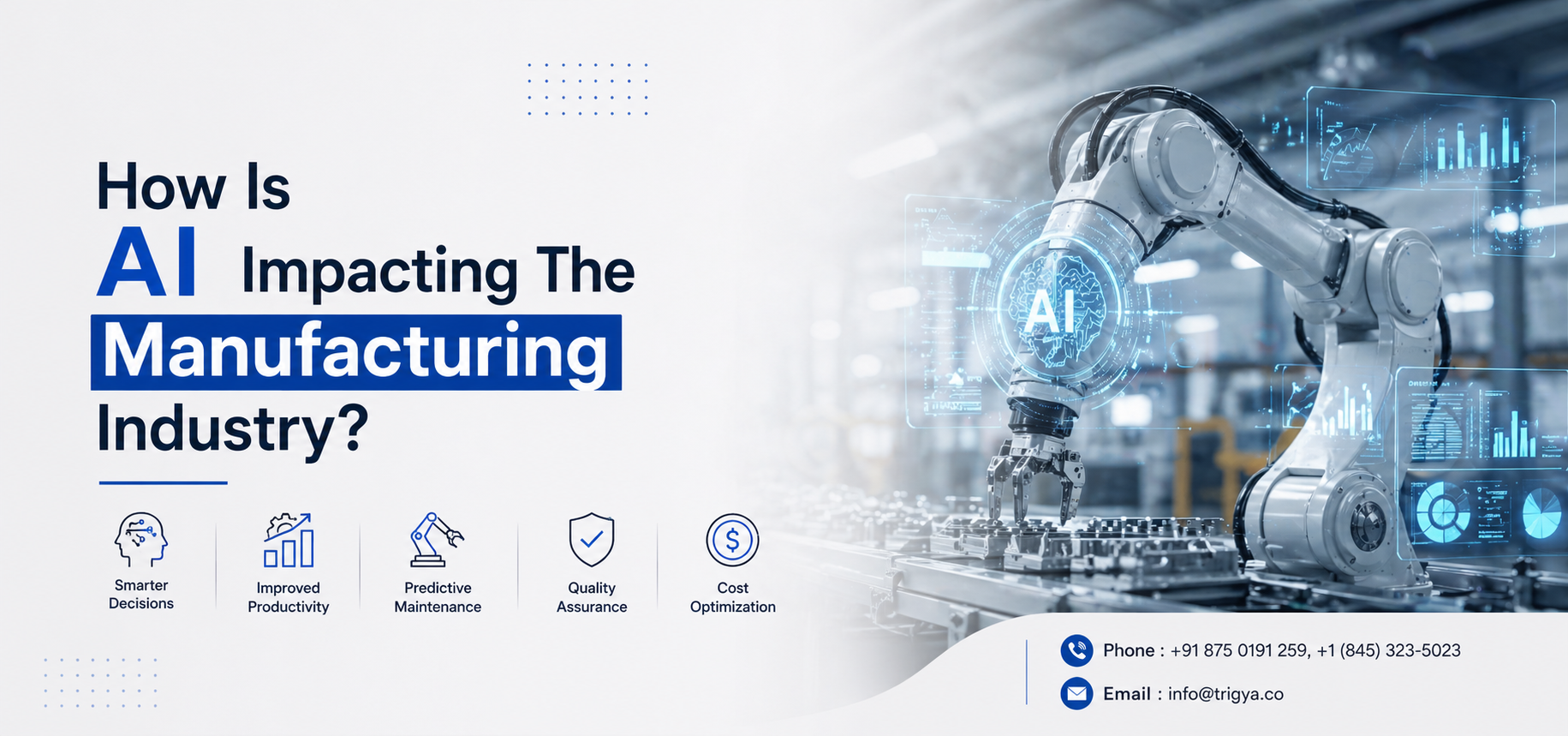
Walk into most factories today, and they look, at first glance, the same as they did a decade ago. Machines hum, workers move between stations, shift supervisors review production logs. Look closer, though, and something has quietly changed. Sensors pulse with real-time data. Algorithms listen for the early rattle of a bearing that is about to fail. Cameras scan each unit on a conveyor belt faster than any inspector ever could. At this point, artificial intelligence has arrived in manufacturing as infrastructure.
The scale of this shift is significant. The global AI in manufacturing market sat at roughly $8.6 billion in 2025, and is projected to surpass $287 billion by 2035, expanding at a compound annual growth rate of around 42%. Those are extraordinary numbers, but they tell only part of the story. The more revealing figure is this: [according to a January 2026 global survey of 300 manufacturing professionals, 98% of manufacturers are exploring or considering AI-driven automation, yet only 20% say they feel fully prepared to use it at scale. Interest is near-universal. Readiness is another matter.
1. The Maintenance Shift
One of the most concrete and measurable changes AI has delivered in manufacturing is in equipment maintenance. For most of industrial history, machines were fixed either after they broke, which is reactive maintenance, or, on a fixed calendar schedule regardless of actual condition. Both approaches carry waste. The former wastes production time; the latter wastes parts and labour.
Predictive maintenance, powered by machine learning, changes this. Sensors on motors, bearings, and conveyor systems feed a continuous stream of data on temperature, vibration frequency, and electrical current into algorithms trained to detect the early signatures of mechanical wear.
This kind of maintenance uses sensor data fed into machine learning models to forecast wear and schedule repairs proactively, rather than halting entire production lines after an unexpected breakdown.
2. Quality Control
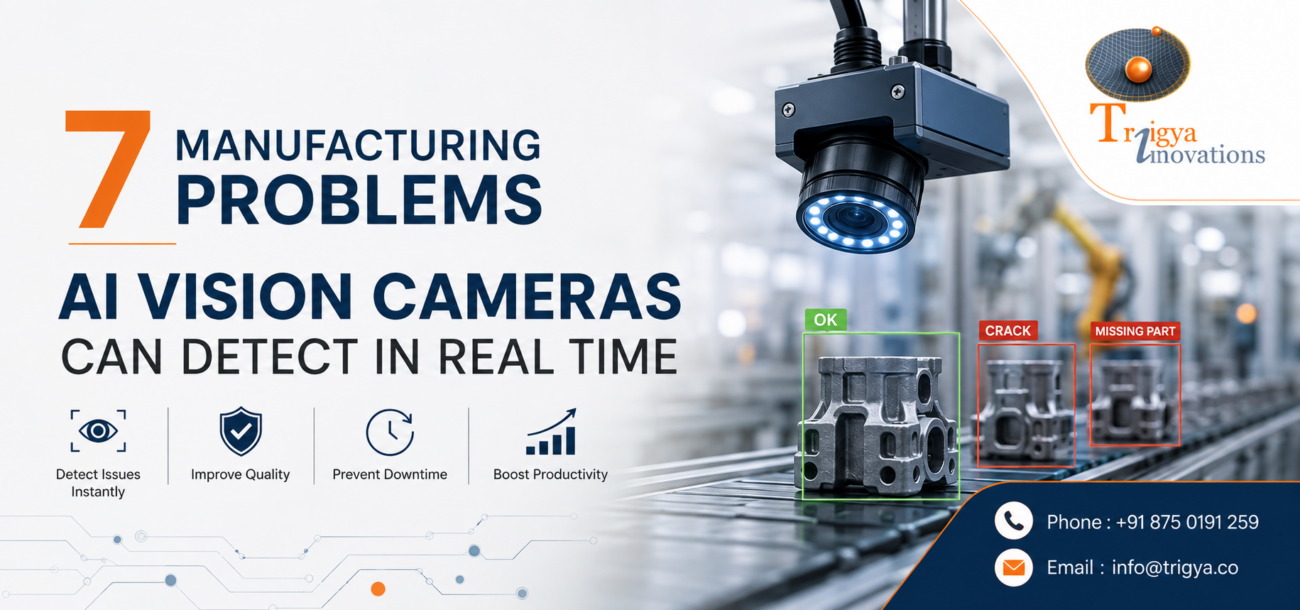
Alongside predictive maintenance, computer vision has become one of AI’s most visible applications on the factory floor. AI-powered computer vision systems are now capable of detecting manufacturing defects with up to 99% accuracy, and 80% of manufacturers plan to use AI-based computer vision for assembly line monitoring by 2026. The practical implication is significant: these systems inspect 100% of units at full line speed, catching microscopic flaws that a human eye would miss.
This does not mean human workers are being replaced wholesale. The more accurate picture, at least for now, is that AI is being deployed on tasks that are physically dangerous, repetitive, or demanding at scales no person can sustain. Workers are being redirected toward roles that require judgment, context, and adaptation. A 2025 Deloitte survey of 600 manufacturing executives found that the top concern for more than a third of respondents was equipping workers with the skills needed to maximize smart manufacturing operations. The technology is advancing; the workforce strategy to support it is still catching up.
3. The Readiness Gap Is Real
This brings us to the honest complication in the AI manufacturing story. The ambition is widespread, and the investment is real, but execution remains fragmented. Seven in ten manufacturers have automated 50% or fewer of their core operations. Only 40% have automated exception handling, even though it is consistently cited as one of the most disruptive processes. And 78% have automated fewer than half of their critical data transfers, which is a bottleneck that prevents AI from operating with real-time context.
The TCS-AWS Future-Ready Manufacturing Study, published in 2025, surveyed 216 senior leaders across automotive, aerospace, and industrial machinery and found that only 21% consider themselves fully AI-ready. The barriers are less about access to AI tools and more about the foundational infrastructure underneath them: aging systems that do not share data, siloed workflows that break at handoffs, and a skills base that has not yet caught up to the pace of deployment.
IDC predicts that more than 40% of manufacturers with production scheduling systems will upgrade to AI capabilities by the end of 2026. But the same analysts are frank: the biggest challenge is architectural. Disparate data sets and fragmented infrastructure mean that even a well-chosen AI tool can underperform if the data it depends on is incomplete or unreliable.
What Comes Next
For manufacturers navigating this landscape, the most useful frame is probably not “how do we adopt AI” but “what problems are we actually trying to solve, and what does solving them require?” The companies reporting the clearest returns in reduced downtime, improved quality, and lower energy consumption tend to be those that started with a specific, measurable problem and built outward from a working solution, rather than those that launched broad AI strategies without clear anchors.
The lesson from 2025, according to observers across the sector, is that AI in manufacturing has moved from being primarily a productivity tool to being a foundation for accountability and long-term reliability. That is a meaningful shift — not just in what AI does, but in what it is expected to be. The factories that treat it accordingly, as infrastructure worth building carefully rather than technology worth deploying quickly, are the ones most likely to benefit from what comes next.
Key Takeaways
- The AI in manufacturing market is projected to grow from $8.6B in 2025 to over $287B by 2035, but adoption readiness lags ambition.
- Predictive maintenance is delivering some of the most concrete ROI: $1.2–3.5M in annual savings from investments of $200K–$600K.
- Computer vision systems now inspect 100% of products at line speed, with up to 99% defect detection accuracy.
- The biggest barrier to AI at scale is fragmented data infrastructure and under-trained workforces.
- Companies succeeding with AI are starting narrow, measuring clearly, and building outward from proven pilots.