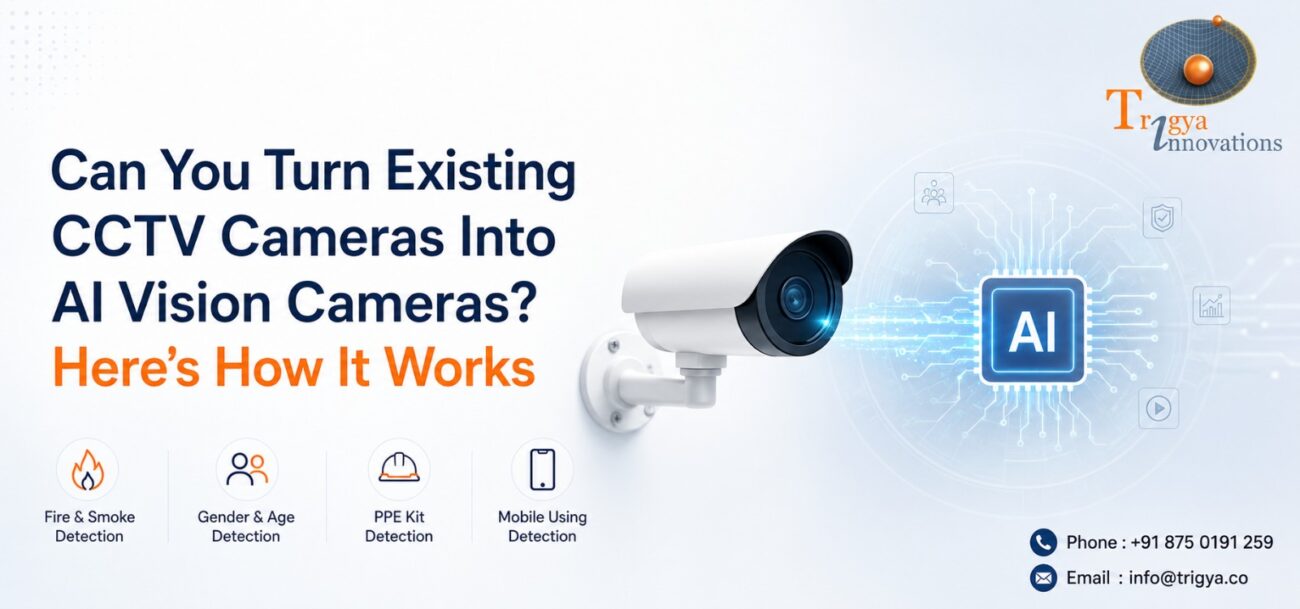


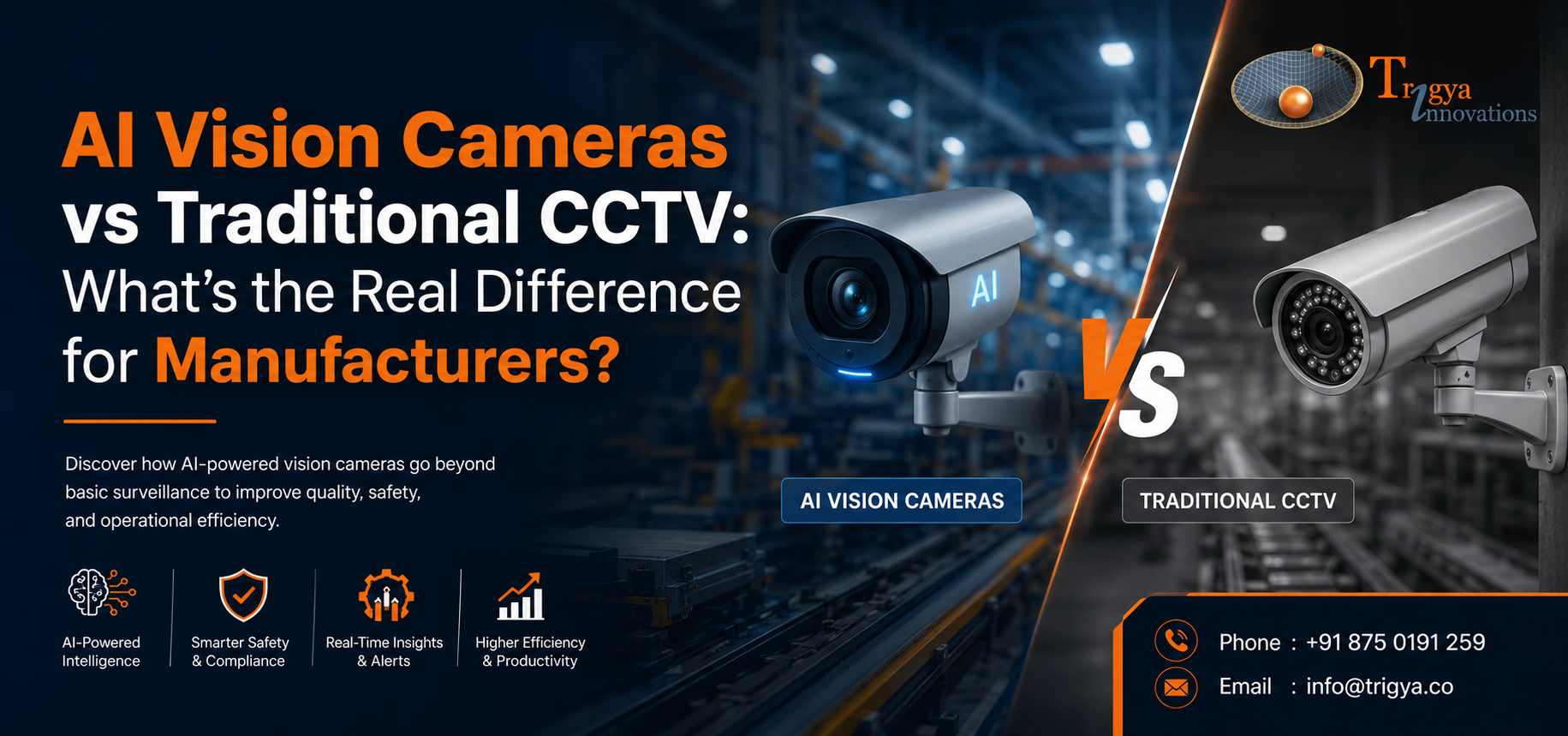
AI vision cameras use on-device computer vision to identify and classify what a camera sees in real time, while traditional CCTV only records footage for someone to review later. For manufacturers deciding where to spend their next security or quality budget, that one distinction changes almost everything else about the decision.
What Is the Difference Between AI Vision Cameras and Traditional CCTV?
Traditional CCTV is a recording system. A fixed camera feeds a DVR, the DVR stores continuous footage, and a person reviews it after something has already happened. It’s built to document, not to intervene.
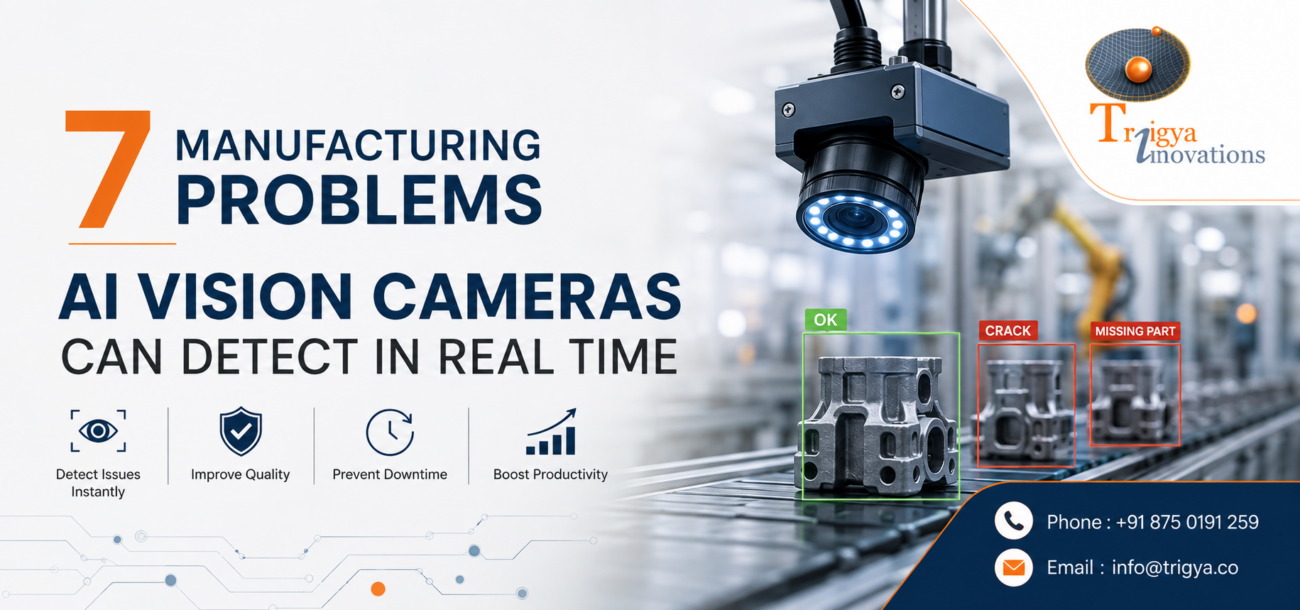
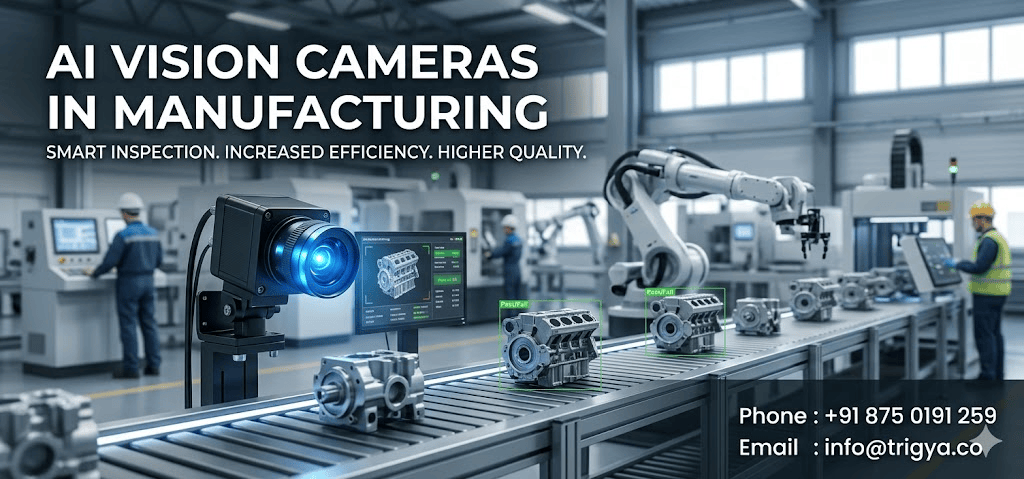
AI vision cameras add a processing layer on top of the same basic hardware. Instead of just capturing pixels, they run neural network inference directly on the camera, classifying what’s in the frame, whether it is a defect, a person in a restricted zone, or a fallen object, as it happens, not after the fact.
How AI Vision Cameras Work
The key mechanical difference is where the analysis happens. AI vision cameras embed inference at the edge, on the camera’s own processor, which drops latency from hundreds of milliseconds down to single digits. That’s what makes it possible to inspect every unit passing on a line instead of sampling a fraction of it.
On the security side, the same principle applies differently. A motion sensor flags anything that moves. An AI-based system classifies what caused the motion, which could be anything ranging from a drawn weapon, a person on the ground, to an unauthorized vehicle. And the system only escalates events that actually matter, cutting down the noise a human has to sift through (IntelliSee).
Where AI Vision Cameras Outperform Traditional CCTV
Catch defects human inspectors miss
Human inspectors miss an estimated 20 to 30 percent of manufacturing defects, even under good lighting and a fresh shift, according to measurements from Sandia National Labs. AI vision systems are now detecting defects at accuracy rates above 99 percent.
Reduce escaped defects and downtime
Manufacturers running AI vision cameras report 30 to 50 percent fewer escaped defects and roughly 40 percent faster changeovers between product runs compared with teams still using rule-based machine vision (iFactory).
Classify threats instead of just recording them
Rather than leaving a security team to scroll through hours of footage after an incident, AI vision cameras push real-time alerts the moment they classify a genuine threat, closing the gap between an event and a response (IntelliSee).
Scale with demand
The industrial machine vision market is on track to pass $9 billion in 2026, and quality assurance and inspection remains its largest single application. That growth reflects manufacturers reallocating existing budgets toward something that measurably lowers scrap and rework, not a speculative trend.
Where Traditional CCTV Still Holds Up
AI vision cameras aren’t the right answer everywhere. Traditional CCTV is cheaper to buy, simpler to maintain, and entirely adequate for low-risk areas, like a storage yard, where continuous recording for later review is all that’s genuinely needed. The premium that comes with AI vision cameras only pays for itself where real-time detection changes an outcome — a fast-moving inspection line or a zone where people and machinery share space (Akisha Networks).
Do Manufacturers Need to Replace Their Existing Cameras?
Usually not. Most AI platforms overlay onto existing IP camera networks through standard ONVIF and RTSP protocols, without rewiring or new mounts (IntelliSee). Trigya Innovations has walked manufacturing clients through exactly this path, layering AI-based inspection and monitoring onto camera networks a plant already paid for, rather than proposing a rebuild from scratch. Framed that way, the real question isn’t CCTV versus AI vision cameras, it’s what a plant’s existing setup is still missing.
Making the Call for Your Plant
Three questions tend to settle the decision:
- What does a missed defect or missed incident actually cost you? The higher the cost, the faster AI vision cameras pay for themselves.
- How fast does the line move? High-speed lines benefit most from real-time, unit-by-unit inspection.
- How much of your existing camera network can be reused? Most manufacturers don’t need an all-or-nothing switch, they run AI vision cameras where errors are expensive and keep CCTV where the stakes are lower.
Ready to improve quality, safety, and operational efficiency? Schedule a consultation with Trigya Innovations to evaluate your current camera infrastructure and identify the most cost-effective AI vision solution for your manufacturing facility.