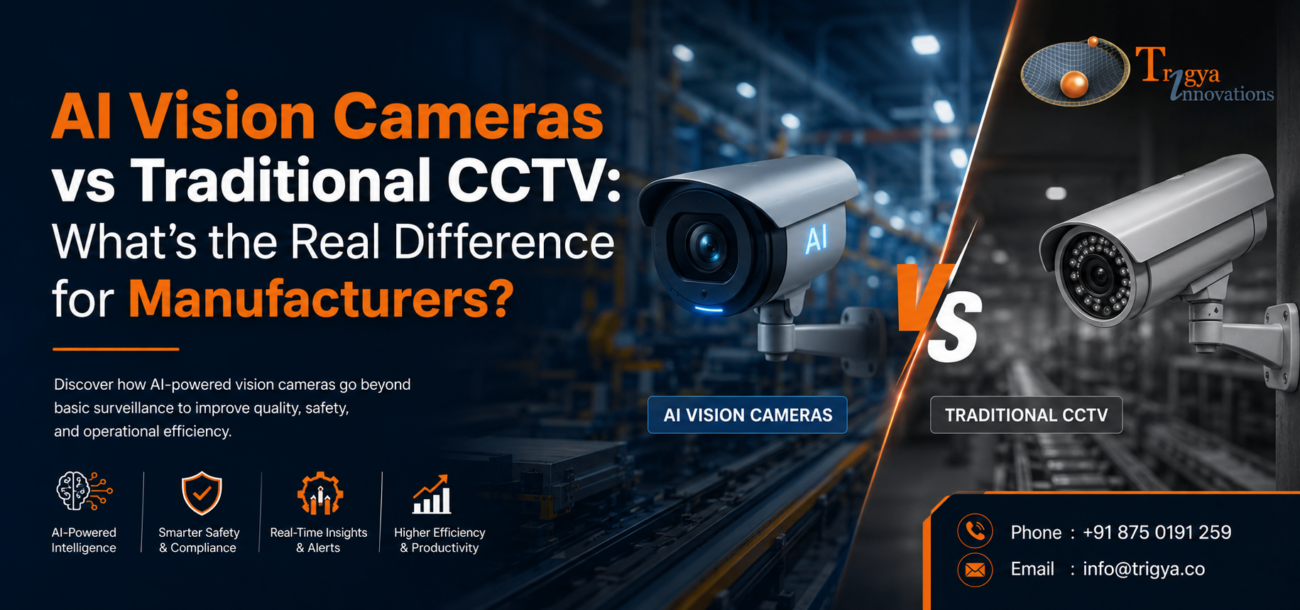


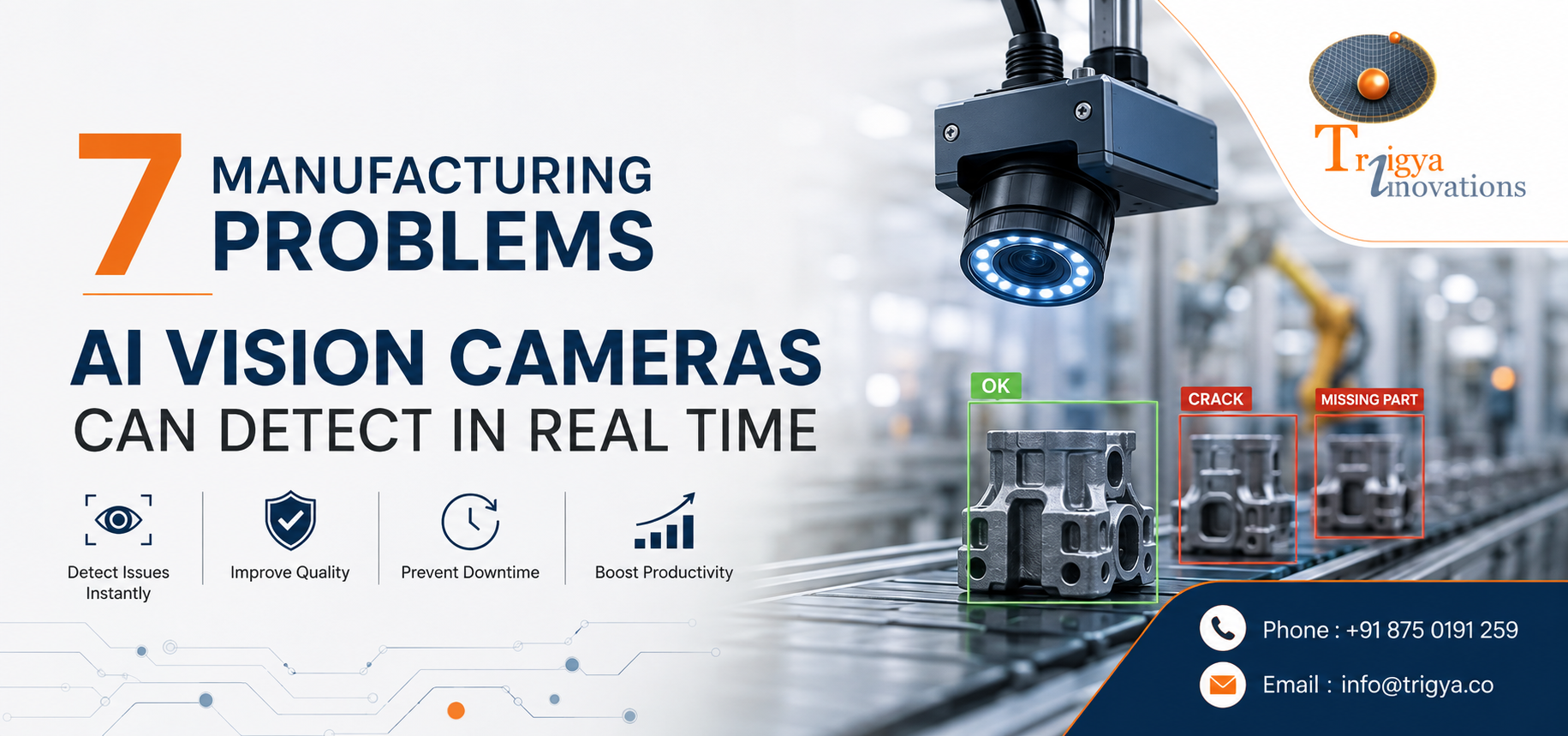
AI vision cameras are cameras equipped with deep learning models that inspect products on a production line as they’re made, flagging defects, dimensional errors, and process issues the instant they occur rather than after a batch has already shipped.
What Are AI Vision Cameras?
An AI vision camera pairs high-resolution imaging hardware with a neural network model, either running on the camera itself or on nearby edge compute. As a part passes the camera, the model classifies what it sees against thousands of examples of good and defective products, then returns a decision in milliseconds. That decision can reject the part, log it, or trigger a downstream alert, all without a human reviewing the image first.
This is a meaningful departure from traditional machine vision, which relies on fixed rules and thresholds programmed for a specific defect type. Rule-based systems break down when lighting shifts or a product varies slightly from spec. AI vision cameras, by contrast, learn from production data and can generalize to defect types they weren’t explicitly trained on.
Adoption reflects that gap. The global machine vision market, valued at roughly $16.1 billion in 2025, is projected to keep expanding through the next decade, with quality assurance and inspection consistently the largest application segment (Grand View Research; Fortune Business Insights).
Below are seven categories of manufacturing problems AI vision cameras are currently used to catch.
1. Surface Defects
Surface defects include scratches, dents, porosity, and cracks on metal, plastic, and painted components. AI vision cameras trained on labeled defect images can detect sub-millimeter surface anomalies at full line speed, including defect variants that weren’t part of the original training set.
2. Dimensional and Assembly Errors
Dimensional errors occur when a part’s measurements fall outside spec; assembly errors occur when components are missing, misaligned, or fitted incorrectly. Cameras paired with structured light or 3D depth sensing measure part geometry and component placement in real time, catching these issues before a sub-assembly moves further down the line.
3. Weld and Solder Defects
Weld porosity, undercut, spatter, and solder bridging are quality issues common to automotive welding and electronics assembly. These defects are costly to catch at final test and difficult to see without magnification. 2D and 3D imaging systems now inspect welds and solder joints inline, at the station where the defect is created.
4. Colour and Contamination Deviation
Colour deviation and contamination affect consistency rather than structural integrity, which makes them easy for a human inspector to miss after repeated exposure to the same product. Cameras equipped with UV or IR illumination detect colour shifts, foreign material, and coating inconsistencies which is a capability particularly relevant to food, pharmaceutical, and consumer goods manufacturing.
5. Label and Packaging Errors
Label and packaging errors include misprints, missing barcodes, and incorrect packaging. These are visual, rule-based errors, which makes them one of the more mature applications of AI vision cameras, with high accuracy achievable even on high-speed packaging lines.
6. Equipment-Linked Defect Patterns
An equipment-linked defect pattern is a recurring quality issue traceable to a specific machine or process step rather than to material variation. When AI vision cameras identify this kind of pattern, image data, defect codes, and timestamps can be routed directly into a maintenance system, opening a work order before the underlying equipment issue causes further scrap.
This is also the point where a lot of manufacturers hit a wall, and it is not with the cameras themselves, but with getting that inspection data to reach the right team actually. At Trigya Innovations we work with manufacturing clients on exactly this gap: connecting AI vision inspection alerts to Zoho Creator workflows or Zoho Analytics dashboards so a flagged defect automatically becomes a maintenance ticket or a quality report, instead of sitting unused in an inspection tool.
7. Novel Defect Variants
A novel defect variant is a defect type the vision model wasn’t explicitly trained to detect. Because deep learning models generalize from a labeled set of good, marginal, and defective parts, they can flag variations outside that training set which is something fixed-threshold machine vision systems are structurally unable to do.
Deploying AI Vision Cameras
An AI vision camera deployment typically starts with a single inspection station rather than a plant-wide rollout. The process involves designing lighting for the specific defect type being targeted, capturing a labeled dataset of good and defective parts, and running the system alongside human inspectors for a shadow period before it operates independently (iFactory).
Manufacturers who complete this process report fewer escaped defects, faster changeovers, and inspection that holds a consistent standard across every shift.
If your production line is still catching most defects at final inspection rather than at the source, Trigya Innovations can help you evaluate where AI vision cameras fit into your existing quality and maintenance workflows, particularly if you’re already running on Zoho and want inspection data to trigger action automatically rather than sit in a dashboard. Reach out to discuss what a pilot deployment could look like for your line.