

Most businesses don’t start with a complex software stack. They begin with a CRM to track leads, an accounting tool to manage invoices, and a few platforms to handle sales, communication, or payments. Over time, as the business grows, these tools multiply. What was once manageable slowly becomes fragmented.
Sales works in the CRM. Finance works in accounting software. Orders live in an e-commerce platform. Payments sit elsewhere. Communication happens over email, WhatsApp, or calls. Each system works, but not together. The result is familiar to many SMEs: repeated data entry, mismatched numbers, delayed follow-ups, and teams operating with partial information.
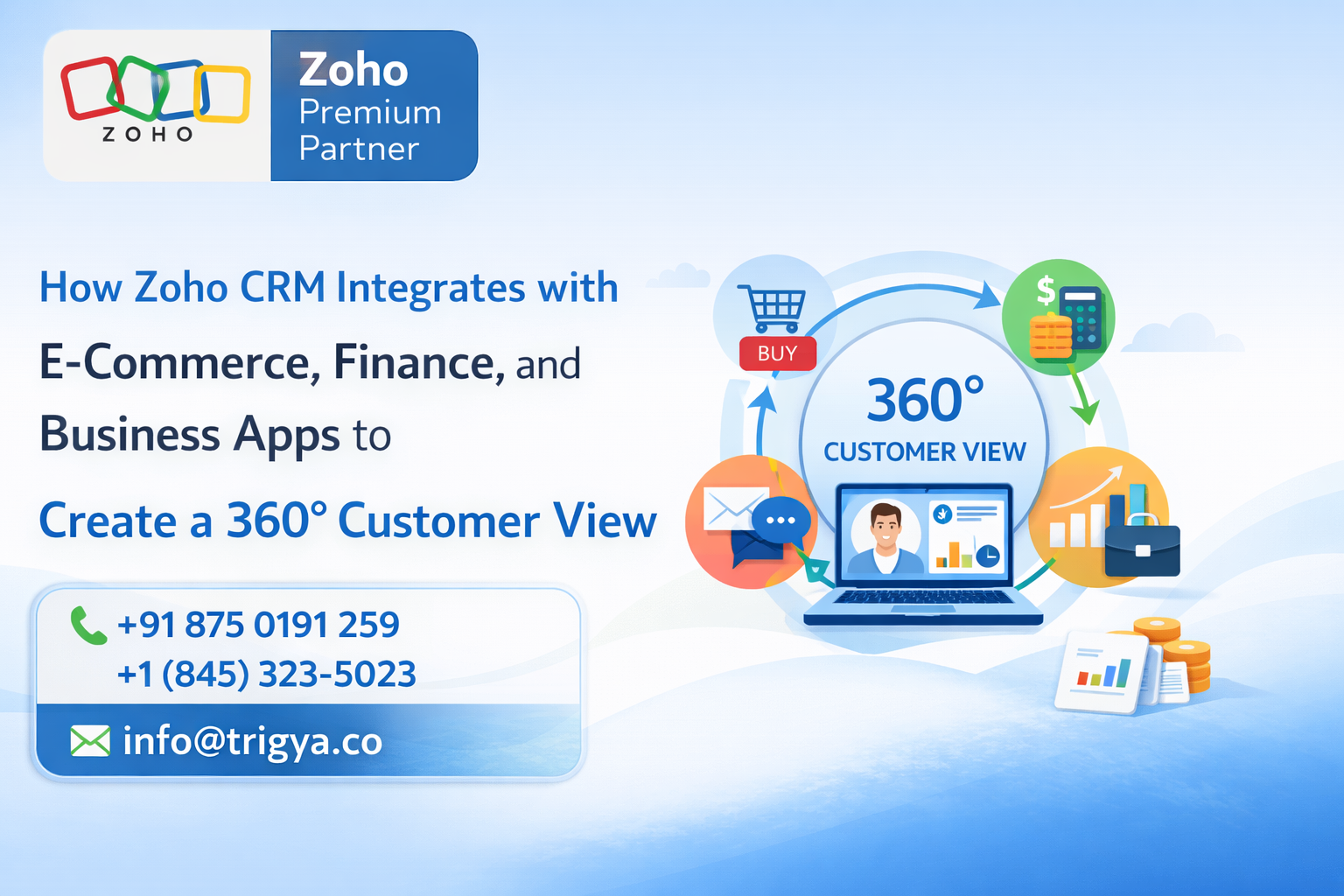
This is where Zoho CRM’s integration capabilities become central—not as a feature checklist, but as a way to bring business context back into one place.
The Role of CRM in a Connected Business Environment
A CRM’s real value shows up when it becomes the reference point for customer activity across the organisation. Zoho CRM is designed to play that role. When implemented thoughtfully, it acts as the layer where sales, finance, operations, and support converge.
In addition to being an excellent Sales Tool (which it is), the Zoho CRM is a live record of your customer’s journey through your organisation. It will allow you to track your leads and turn them into customers, track your conversations with customers and eventually convert them into orders, and track all customer shopping orders all the way to invoicing and payment processing. Each of these three interactions provides a “record” of the customers’ interactions, and at each point in the journey, you can see, understand, and take an action based on your customers’ interaction(s) with your company.
For many Indian SMEs, this impact is magnified. Many SME’s deal with high volume transactions and have small teams, making it almost impossible to be able to do manual reconciliation of all their transactions and chase after information across multiple systems. Integration is not simply an upgrade or nice to have – it’s a basic requirement for any successful business.
Connecting E-Commerce Platforms to Zoho CRM
Zoho CRM users frequently request the ability to connect e-commerce applications to their Zoho CRM account. Although platforms such as Shopify and WooCommerce do provide excellent solutions for managing the store front end and payment processing, on their own they lack a complete view of your customers.
Once an e-commerce platform is integrated with Zoho CRM, the customer’s e-commerce activity becomes less anonymous. Orders are no longer just transactions; they are tied to real people, purchase histories, and ongoing relationships.
A repeat customer will be identified when he/she places multiple orders. When a customer makes a significant purchase, a follow-up from sales or customer support can be initiated. Rather than viewing abandoned shopping carts as lost revenue, businesses can now see that they are simply missed opportunities to interact with the customer and convert them into an actual sale.
From an implementation standpoint, the most complex part is not deciding on which system to connect to but rather defining how the data should flow between the two systems. What qualifies as a lead? When should a deal be created? How should returns or cancellations be handled? These decisions shape whether the integration actually supports decision-making or simply adds more data.
Bringing Payments and Finance into the Same View
Payments and accounting are often kept separate from CRM systems, even though they are directly linked to sales outcomes. This separation creates blind spots. Sales teams may not know whether a deal has been paid for. Finance teams may not have clarity on deal context or commitments made to customers.
The integration of Zoho CRM with payment processing services (for example, Razorpay) and accounting software (like Zoho Books) closes this information gap.
When payments update deal records automatically, follow-ups become timely and relevant. When invoices are generated based on confirmed deals, errors reduce. When customer financial data is consistent across systems, reporting becomes more reliable.
In India, where compliance with Goods and Services Tax (GST) and audit readiness are priorities, this synergy between CRM and finance supports businesses in better managing their time and reducing risk. The CRM transitions from being solely a tool for managing sales to supporting the entire financial workflow within an organization.
Communication Tools and Day-to-Day Context
A bulk of customer contact occurs outside CRM systems. It happens via email, phone calls, calendars, and internal messaging, all of which can provide additional context. But, when this communication stays outside the CRM, important context is lost.
By integrating Zoho CRM with Gmail, Outlook, telephony and collaborative applications, these extra details can be captured automatically. Customer emails are connected to customer records in the system, phone calls are recorded without the need for any manual input, and meetings can be viewed as part of the overall progress of an opportunity.
This matters because CRM data is only as good as its completeness. When communication flows naturally, teams don’t have to “maintain” the CRM—it reflects reality on its own.
Native Integrations and When Third-Party Tools Are Needed
Zoho’s ecosystem, particularly in the case of Zoho One, has an advantage because of its native integrations. The applications that fall within Zoho’s One suite, such as Books, Inventory, Desk, Campaigns and Analytics, are integrated with each other in order to share data and information easily with as little friction as possible between the applications.
This is an excellent place for many SME’s to build their business upon. Using fewer number of connectors means less chance for failure, and therefore easier long-term maintenance.
That said, businesses don’t always operate entirely within one ecosystem. Industry-specific tools, legacy systems, or external platforms often require third-party integrations or custom workflows. Zoho addresses this through Marketplace extensions, Zoho Flow, and APIs.
Choosing between native and third-party solutions is not just a simple choice of one or the other; instead, it is about weighing the benefits of each against the drawbacks. Native solutions generally provide more stability, whereas third-party solutions allow for greater flexibility. Most effective CRM configurations will utilize a combination of both types of solutions that are designed around how the business operates.
Where Zoho One Fits into the Bigger Picture
Zoho One simplifies integration by design. By offering a unified suite of applications under a single subscription, it reduces the need to connect any systems that are outside the Zoho ecosystem. For growing SMEs, this can significantly lower complexity.
However, Zoho One is not automatically effective just because the tools are connected. Without clear workflows, proper permissions, and structured data movement, silos can still exist inside a single suite.The difference lies in implementation—how modules are configured, how data ownership is defined, and how teams are trained to use the system consistently. This is where implementation discipline matters. As a premium zoho partner Trigya Innovations, helps businesses with the end-to-end implementation of Zoho tools, this encompasses designing structured CRM, finance, and e-commerce workflows that are easy to use. With the right configuration and training, we make sure Zoho CRM becomes a true operational backbone your team can rely on.
If you’re looking to build a single, reliable view of your customers, get in touch with our team to discuss your Zoho CRM integration needs.