

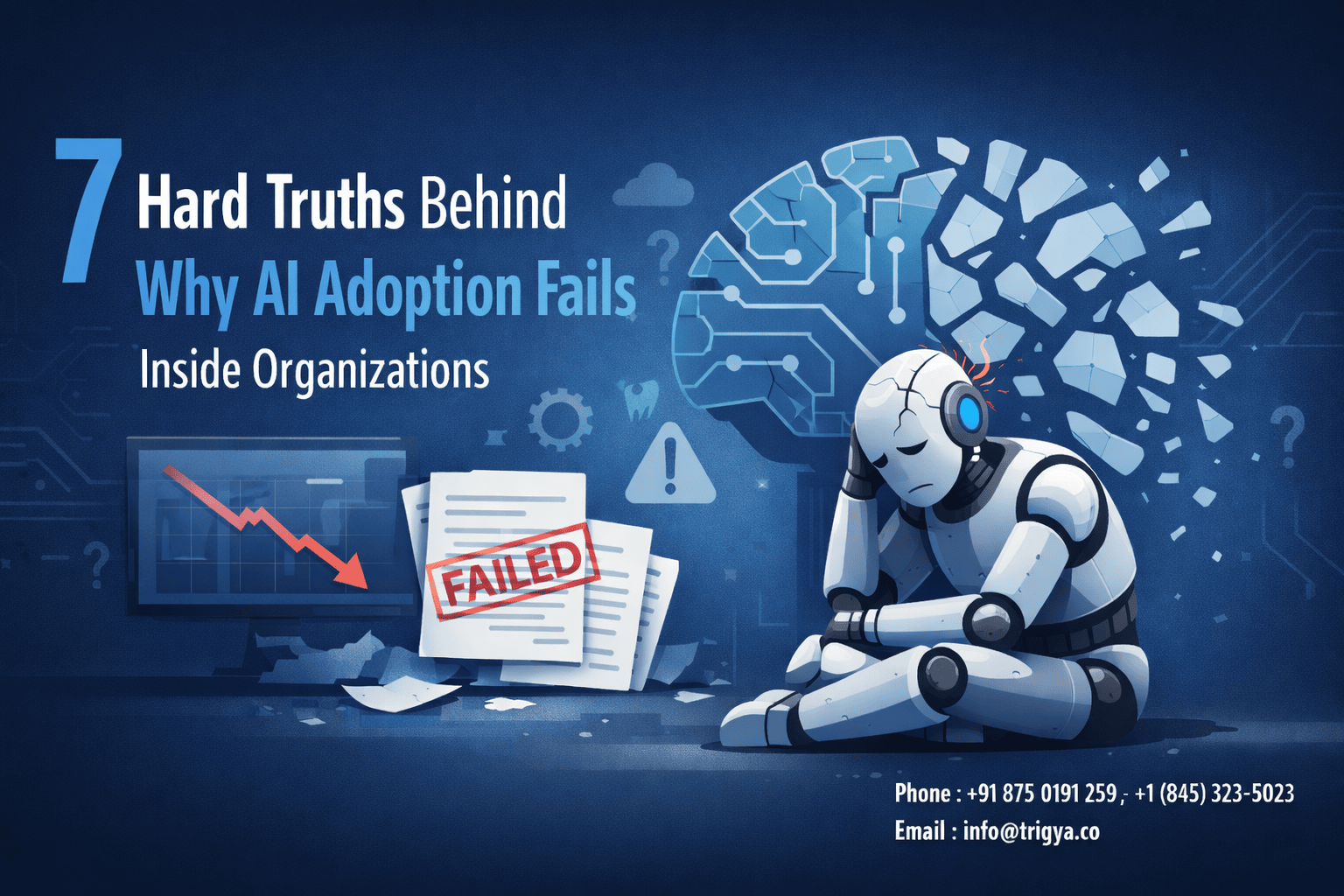
Approximately 80% of companies globally are using AI in some form, but only 20% of them have meaningful AI integration. Even this data isn’t very straightforward, as the companies that are truly AI native are less than 10% around the world. The truth is almost every business leader has used AI to perform some kind of task, such as writing an email, summarising a report, etc., But, very few organizations have been able to adopt AI and managed to scale it to a reliable business capacity. In this blog post, we tried to address 7 truths that address the gaps in AI adoption :
1. Lack of Accountability
Remember the time when ChatGPT got launched in 2022, every one of us got so intrigued by how intelligent it felt. Most people try AI out of curiosity, but the true leverage comes when AI is tied to an actual business process, a clear outcome, and defined KPIs. This kind of structure allows a business to stay accountable and truly leverage AI in its workflows. Without accountability, the curiosity quickly fades without yielding any tangible value.
If you’re a business owner, your role holds the key to making sure that accountability is built into how your team uses AI.
2. Affordable Tools But Costly Changes
AI tools are increasingly accessible to everyone with affordable plans and free trials. What is expensive are the structural changes at a fundamental level. That includes redesigning the workflows and training teams to operate differently. So, the real cost organizations have to pay is the time they spend redesigning their systems and the resistance from teams to adapt to the new changes.
Starting small and then scaling is a great way forward. Also, expect resistance from employees and build simple SOPs accordingly, proactively talk about AI, and educate your team about its positive impact on their skills in the long run.
3. Poor Quality of Data
The efficiency of any AI tool is highly dependent on the quality of the data the tool is trained upon. The AI demos assume clean and well-labelled data, they look feasible. However, many organizations have fragmented systems, years of messy and unstandardized data, which impact the quality of the output negatively. It’s important to remember that any AI tool is as good as the data it is fed with.
4. Multidimensional Transformation
Do not assume that adopting AI at work is a technical decision alone. AI integration changes the existing workflows across domains, redefines how decisions are made, and shifts ownership across the organization. Therefore, it is a multidimensional decision that requires people across domains to come together who understand AI and its impact on driving the outcomes.
5. AI Governance
Governance is an overlooked part of AI adoption, which can later cause problems. It should be acknowledged that a lot of decisions regarding hiring & people decisions, credit approvals, pricing, customer experience, marketing, supply chain, etc., are now being hugely influenced by AI. In all the above cases, AI isn’t helping but rather shaping the outcomes. So, it’s on the organizations to be accountable for whether the decisions made by AI are actually fair, unbiased, following compliance, etc. Otherwise, these decisions made at scale in the longer run can create problems that’d affect both the people (customers and employees) and the company’s reputation as well.
6. Scaling
Scale is where the capability of an AI model is truly tested. Many times, what works in a small team may not work across large teams, different regions, languages, and versatile real-life situations. At this point, the focus shifts to infrastructure, i.e., where the AI model is hosted and how the data flows into it. Continuous monitoring to catch any performance drops and retraining the model to keep it up-to-date also becomes critical. Therefore, scaling AI isn’t a one-time effort; it requires you to be on your toes most of the time to keep the systems reliable, relevant, and running smoothly at all times.
7. Efforts from the Leadership
Organizations that are serious about AI adoption can’t afford to treat AI as an experiment or a side project that sits in isolation. The key functions within an organization, which constitute business, technology, finance, legal, and operations, should come together for a holistic adoption. Only then can it be scaled to a reliable business capacity.