

Every business eventually hits a wall with spreadsheets and disconnected tools, and that’s usually when the word ERP starts coming up in leadership meetings. Zoho has positioned itself as one of the more accessible answers to that problem. With a suite of over 45 integrated applications and the most affordable pricing, it’s easy to see the appeal. Here are 7 things you should consider before you commit :
1. Understand What Zoho ERP Actually Is Today
The conversation about Zoho ERP has changed significantly in 2026. Zoho launched its ERP platform in India in February 2026, integrating core financials, supply chain management, omnichannel commerce, billing, payroll, travel and expense management, procurement, and spend management into a unified system. Unlike traditional ERP systems that handle payments through external tools, Zoho has built payment processing directly into the platform, automatically linking collections, vendor payouts, and salary disbursements to orders, invoices, and ledgers.
For businesses that have historically managed Zoho as a collection of individual apps, that shift toward a genuinely unified system changes the calculation. Before evaluating pricing or features, first clarify which version of Zoho fits your operational reality. Is it the bundled Zoho One approach or the new dedicated ERP platform?
2. Know Where Zoho Drives the Strongest ROI
Zoho performs particularly well in specific contexts, and understanding that fit helps you set realistic expectations. Zoho ERP offers the highest ROI for medium-sized businesses in the retail and service sectors that value speed and ease of use, providing customer relationship management, financial reporting, and marketing automation in a cohesive package without requiring a large IT department.
3. Evaluate Your Customisation Depth Honestly
This is one area where the honest answer genuinely depends on your business, not on any flaw in Zoho. Zoho prioritises simplicity and quick deployment, making it the right choice for businesses that need fast setup and minimal technical effort. Platforms like Odoo, by contrast, offer deeper open-source customisation for businesses with highly complex or non-standard manufacturing workflows — but that depth comes with greater implementation complexity and longer timelines. Zoho typically offers faster implementation times due to its standard features and user-friendly interface, allowing businesses to quickly set up and start using applications with minimal downtime and disruption.
4. Factor in the Full Cost of Ownership
ERP pricing is rarely what it appears on the surface, regardless of vendor. With Zoho, implementation costs, data migration, priority support, and customisation can meaningfully impact the total budget. That said, Zoho’s pricing model is considered one of its genuine strengths.
What makes Zoho worth serious consideration is where it sits in the market. SAP, Oracle, Microsoft Dynamics, and NetSuite have long dominated the ERP space. However, for many mid-sized businesses, those platforms can be too complex and expensive than the operation actually needs. Zoho covers the same fundamental ground at a fraction of the cost.
The practical advice before signing up: think about where your business will be in two to three years. Map out how many users you’ll need, how your order volumes might grow, and whether you’ll need external help to set the system up properly. Those numbers, added together, give you a far more honest picture of what Zoho will actually cost, and whether it’s the right fit.
5. Take the AI Integration Seriously
This is where Zoho has made its most notable 2026 investment, and it’s worth understanding before you decide. Unlike traditional ERPs that add the AI layer an afterthought, Zoho ERP embeds its AI assistant Zia natively across every module, delivering predictive cash flow, sales forecasting, stock optimisation, and pattern recognition as part of standard pricing.
6. Plan Your Implementation Strategy Before Day One
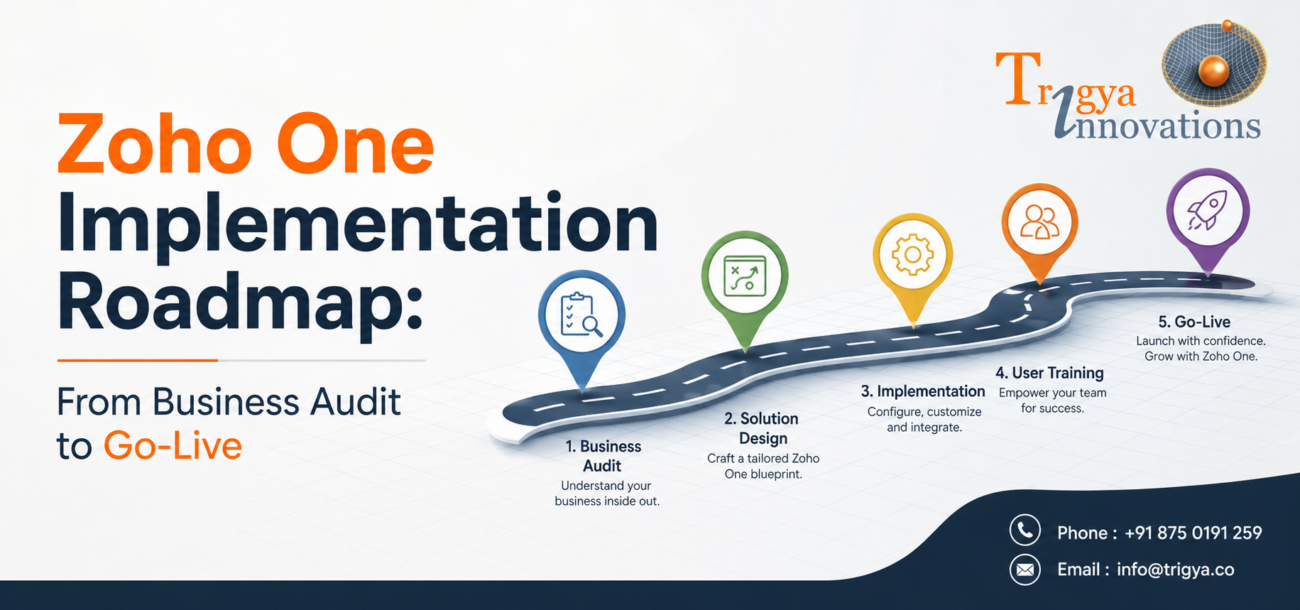
The businesses that struggle with any ERP tend to underestimate implementation as a strategic activity. User adoption depends on structured training, communication, and stakeholder involvement. Configuration should support current operations while remaining flexible for future growth, and partnering with an experienced ERP consulting team ensures smoother deployment, risk mitigation, and faster ROI realisation. It’s a great way to approach it in a gradual manner rather than forcing a disruptive replacement.
At Trigya Innovations, we offer phased transformation, starting with three to five core modules and expanding horizontally, which is a common and sensible path, especially for teams migrating from legacy systems.
7. Consider Zoho’s Long-Term Trajectory
A software decision isn’t just about what a platform does today; it’s about where the vendor is headed. On this front, Zoho’s position in 2026 is arguably stronger than it’s ever been. Zoho is seeing strong traction from businesses migrating from legacy systems such as SAP and Microsoft Dynamics. While providing an integrated platform for businesses, Zoho serves as a digital nervous system for the enterprise.
It’s also about time; enterprises should put Zoho on their radar and change their perception that Zoho is just small and midmarket-focused. Because, a platform with a 30-year track record, a clear upmarket trajectory, and genuine analyst recognition is one you can build on with confidence.
The Bottom Line
Zoho ERP is a well-built, continuously evolving platform that delivers genuine value, particularly for service businesses, retailers, and growing SMBs that want operational coherence without enterprise-scale complexity. The considerations above aren’t the questions any serious evaluation should include.
If you’re looking for ERP implementation and not sure where to start, let’s help you out with our free consultation. Our experts at Trigya Innovations inquire customisation requirements, model your total cost, plan your implementation, and align Zoho’s strengths with your actual operating model. Let’s talk !