
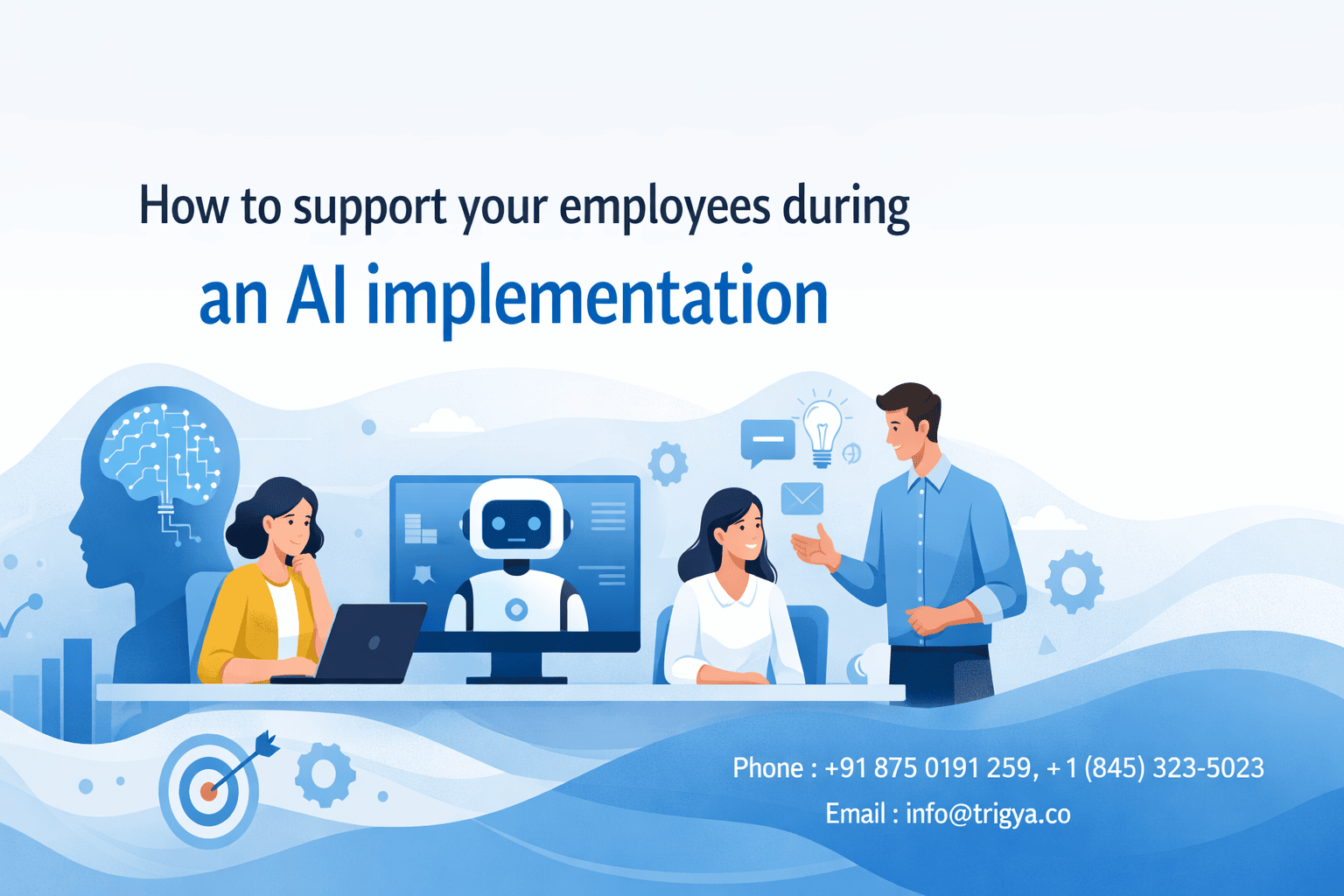
If you’re rolling out AI across your organisation, you know it is as much a people challenge as it is a technical one. Here’s how to bring your team along in a way that increases adoption across your organisation.
When an organisation decides to implement AI, the instinct is often to focus on the technology stack i.e., choosing the right tools, building pipelines, and optimising workflows. But the harder, more important question is how are you going to include employees in the process and help them understand those tools? What’s your plan to make them more informed, capable, and safe?
The truth is, even the best of the AI models and their implementation may not fully come to fruition if the employees aren’t brought along for the journey. When employees are under-trained, they feel anxious and resistant towards the technology. Supporting your workforce through AI adoption is the fundamental part of any AI implementation strategy.
Why Supporting Employees Matters More Than You Think?
Fear is a natural response to change. Employees wonder whether their role will be automated away, whether they’ll be left behind in a skills gap, or whether leadership is being fully transparent. Before you deploy any new tool, understand that these concerns are already on the employee’s mind, whether they express them or not.
Here are 4 things that can build more trust among your employees:
i. Transparent communication
Be transparent about the uncertainty associated with the adoption timelines, job impacts, and what the AI actually can and can’t do. Tell people what is changing, why, and what you don’t yet know.
ii. Targeted upskilling
Avoid pushing generic AI literacy decks to everyone; make sure the training you offer is matched to their roles. When AI training reflects their actual job roles, they’d be interested to engage.
iii. Psychological safety
Give your employees space to ask “basic” questions. Also, expect some early mistakes while they get used to the technology.
iv. Feedback loops
The fastest and the most accurate way to improve your AI implementation is to listen to employees who are using it daily. The gaps that may not appear during demos can show up in actual use.
3 Phases of a Successful AI Implementation
Any good AI change management doesn’t happen at once but rather unfolds in phases with different kinds of support needed at each stage.
i. Before Launch :
This is the time to set honest expectations. Be upfront and share the “why” behind the decision. Explain what the AI tool will handle, what it won’t, and which roles will experience the most change. Involve team leaders early so they can answer questions from the individuals they are managing.
ii. During rollout :
This is the toughest yet the most rewarding part. When you’re training your employees, train them for the actual workflow and the tasks they do daily instead of a generic training. Show them exactly how the tool fits into their existing process as a co-pilot.
For safe experimentation, configure access early so each role only reaches the capabilities they need. This keeps live work unaffected while giving people room to explore, which is a great way to build confidence without compliance risk.
iii. Post-launch
This is the phase where you should listen more. Because, the first 90 days after an AI deployment are when employee trust is either built or eroded. Create dedicated feedback channels through which you can take feedback on a regular basis. Find out the common problems across roles and role specific problems they are facing and act visibly on what you hear.
A practical checklist for people managers
- Before launching organize a pre-launch briefing that emphasises both the opportunity and the uncertainty
- Identify the two or three roles that will feel the biggest shift and create tailored onboarding paths for these roles.
- Designate individuals who are comfortable with the tool to help a colleague when they get stuck.
- During team meeting normalise talking about AI limitations along with the wins.
- Review and revise the job descriptions within 6 months after the launch and make sure they reflect new AI-augmented responsibilities
- Celebrate early adopters publicly, because the behaviour you recognise is behaviour that spreads and reinforces
Wrapping Up
Organisations that invest in this kind of employee-centred AI change management report measurably better outcomes. The results include higher tool adoption rates within the first quarter and reduced error rates as employees gain confidence.But, most importantly, this kind of approach helps the workforce to see AI as a co-pilot rather than their replacement.
None of this requires a huge budget. It requires honesty, consistency, and the willingness to slow down the rollout slightly to bring people along properly. That patience almost always pays for itself.
AI implementation is ultimately a human project. The technology will evolve faster than any training programme can track. However, when employees trust its leadership, they learn the technology better and will adapt to almost anything. That is the real competitive advantage.