

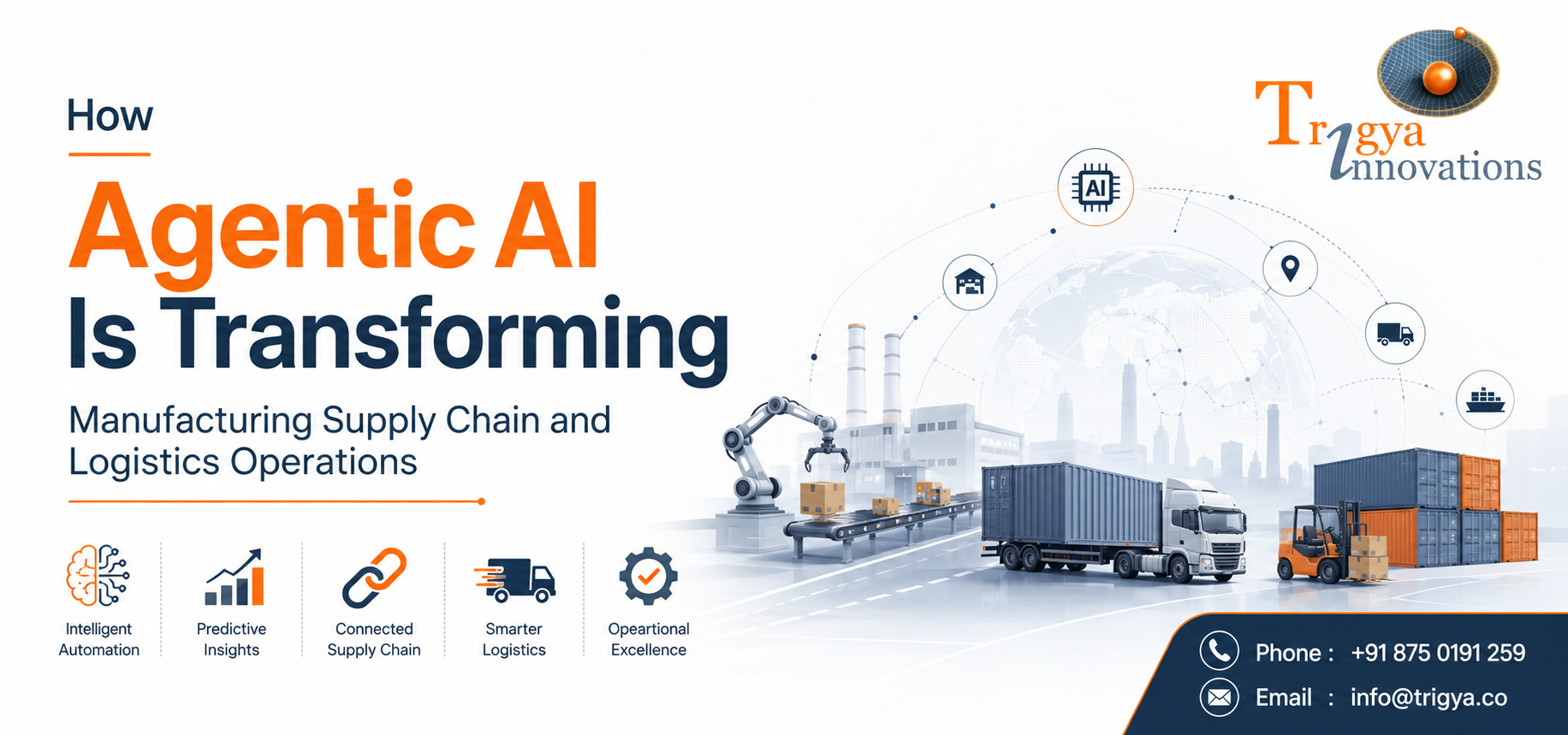
Over the past few years, AI has moved into the daily rhythm of manufacturing plants, warehouses, and procurement desks. Leading this shift is agentic AI in manufacturing supply chain systems, tools that don’t just flag a problem but act on it within limits a company sets in advance. For plant managers, logistics leads, and operations teams, understanding where this technology actually helps is becoming essential.
This article breaks down what agentic AI is, the benefits it brings, and the top real-world use cases reshaping manufacturing and logistics today.
What Is Agentic AI in Manufacturing Supply Chain?
Traditional supply chain software follows fixed rules. It raises an alert and waits for a person to decide what happens next. Agentic AI in the manufacturing supply chain works differently. It can sense a change, such as a delayed shipment or a machine slowdown, weigh a few possible responses against business rules, and carry out the best one, then log exactly what it did. Gartner lists this kind of autonomy as one of the top supply chain technology trends for 2026, alongside physical AI and multi-agent systems that coordinate planning, procurement, and logistics together.
Key Benefits of Agentic AI for Manufacturers
- Faster Exception Handling. Instead of waiting hours for a person to notice a delay, agents resolve routine exceptions the moment they appear.
- Leaner, Self-Balancing Inventory. Stock levels adjust automatically before a shortage turns into a missed order.
- Stronger, Data-Backed Decisions. Agents pull from live data across ERP, warehouse, and transport systems, so decisions reflect what’s actually happening on the ground.
- Lower Operating Costs. Fewer manual handoffs mean fewer delays and less overtime spent firefighting.
- Better Visibility Across Partners. Suppliers, carriers, and internal teams work off the same real-time picture instead of separate spreadsheets.
Deloitte reports that more than half of supply chain executives are already using AI agents in production, and expects that by 2030, half of all cross-functional supply chain platforms will let agents execute decisions on their own, based on Deloitte’s manufacturing research. Separately, enterprises already running these systems report roughly fifteen percent lower logistics costs and thirty-five percent better inventory accuracy, according to a 2026 global enterprise survey.
With the benefits in view, here’s where agentic AI in manufacturing supply chain is showing up in day-to-day operations.
Top Use Cases of Agentic AI in Manufacturing and Logistics
1. Production Scheduling That Adjusts Itself
- Reschedules jobs automatically when a machine slows or a part runs short
- Reprioritizes orders based on live floor conditions, not a static plan
Business Impact: Keeps production moving without waiting for a supervisor to notice and manually replan.
2. Self-Balancing Inventory Management
- Rebalances stock across warehouses before a shortage hits
- Flags only the exceptions that genuinely need human judgment
Business Impact: Estée Lauder uses this kind of agentic decision intelligence to support thousands of daily supply chain calls, balancing cost, service levels, and sustainability, while people still set the guardrails, per reporting on Aera Technology’s platform.
3. Procurement Exception Resolution
- Detects a supply gap, checks alternate vendors against pre-set rules, and updates the purchase order
- Removes the usual cycle of escalation calls and manual approvals
Business Impact: SAP notes this “human plus machine” approach lets copilots handle repetitive analysis while people focus on real judgment calls, based on SAP’s 2026 supply chain outlook.
4. Logistics Routing and Dispatch
- Plans delivery routes using live traffic, weather, and vehicle data
- Re-plans mid-route when conditions change, without a coordinator stepping in
Business Impact: A European logistics provider used agentic AI across five core systems to cut ticket resolution time from hours to about ninety seconds, reaching over ninety-nine percent autonomous handling, according to a detailed logistics case study.
5. Demand and Shipment Optimization
- Reviews thousands of daily shipments and adjusts routing, timing, and vendor choice
- Flags only true exceptions for human review
Business Impact: General Mills built exactly this kind of system, reviewing more than five thousand shipments a day and generating over twenty million dollars in savings since 2024, according to recent enterprise AI case studies.
6. Warehouse Coordination
- Coordinates robotic pickers, conveyors, and human workers in real time
- Adjusts task assignments as order volumes shift through the day
Business Impact: Manufacturing Dive notes that self-balancing inventory and real-time production adjustments let manufacturers run leaner without losing flexibility during disruptions, based on their coverage of 2026 manufacturing trends.
How to Get Started with Agentic AI in Manufacturing Supply Chain
Step 1. Map Where Delays Actually Happen. Look for the workflows where exceptions pile up, whether that’s procurement, inventory, or dispatch.
Step 2. Check Your Data Foundation. Agentic AI in manufacturing supply chain only works as well as the ERP, inventory, and logistics data feeding it. This is where much of the groundwork Trigya Innovations does as a Zoho One Premium Partner matters, connecting these systems cleanly before any AI layer gets added.
Step 3. Start Narrow. Pick one workflow, set clear rules, and keep a full audit trail of every action the agent takes.
Step 4. Review, Then Expand. Track results and widen the scope once the first workflow proves out. Gartner’s research places “trust and governance” as a core 2026 theme, meaning clear accountability matters as much as the technology itself, per the same Gartner trends report.
Conclusion
Agentic AI in manufacturing supply chain is no longer a future concept. It’s running in warehouses, procurement teams, and production lines today, with measurable savings behind it. The manufacturers seeing the biggest gains aren’t always the ones with the flashiest tools. They’re the ones that started small, kept people in the loop where it counts, and built on data that was already in good shape. For businesses running on Zoho, Trigya Innovations works alongside teams to get that data foundation right, so the next step into agentic AI is a natural one.
FAQs
Does agentic AI replace supply chain planners?
No. Most deployments keep a human in the loop for judgment calls and only automate routine exceptions.
What’s the difference between agentic AI and regular automation?
Regular automation follows fixed rules and waits for a person to act. Agentic AI evaluates options and takes the next step on its own, within pre-set limits.
Where should a manufacturer start?
Begin with one high-friction workflow, such as procurement exceptions or inventory rebalancing, and expand once it proves out.
Is this only for large enterprises?
No. Mid-size manufacturers and 3PLs are seeing measurable results too, especially once their core systems are well integrated.
How does Trigya Innovations help manufacturers prepare for agentic AI?
Trigya unifies your fragmented operational systems into a single Zoho ecosystem. This delivers the clean, real-time data foundation required for agentic AI to make safe, autonomous decisions.