
The conversation around Zoho One digital sovereignty has moved from policy papers to prime-time news. When PM Modi publicly acknowledged Zoho founder Sridhar Vembu at a national conclave on June 22, 2026, it was not just a moment of recognition for one entrepreneur. It was a signal that India’s digital infrastructure strategy has a clear direction, and that Zoho sits near the centre of it.
For businesses evaluating their technology choices, this is worth paying attention to.
What Has Actually Happened
The scale of India’s shift to Zoho is hard to ignore. The Government of India migrated 16.68 lakh (1.668 million) official email accounts across central ministries to Zoho’s cloud platform, at a cost of approximately ₹180 crore. This was not an overnight call, the National Informatics Centre (NIC) ran proof-of-concept evaluations through a GeM bidding process before selecting Zoho, with per-account pricing between ₹170 and ₹300.
The Ministry of Education followed up with a formal memorandum directing officers to adopt Zoho’s suite of applications as a move toward reducing dependence on foreign platforms. Migration began in 2024–25 and was completed by April 2026.
This is a policy commitment at scale. For businesses, particularly those working with government clients, regulated industries, or compliance-heavy workflows, understanding what drove this decision is practical, not academic.
Why Zoho One Makes Sense as a Platform
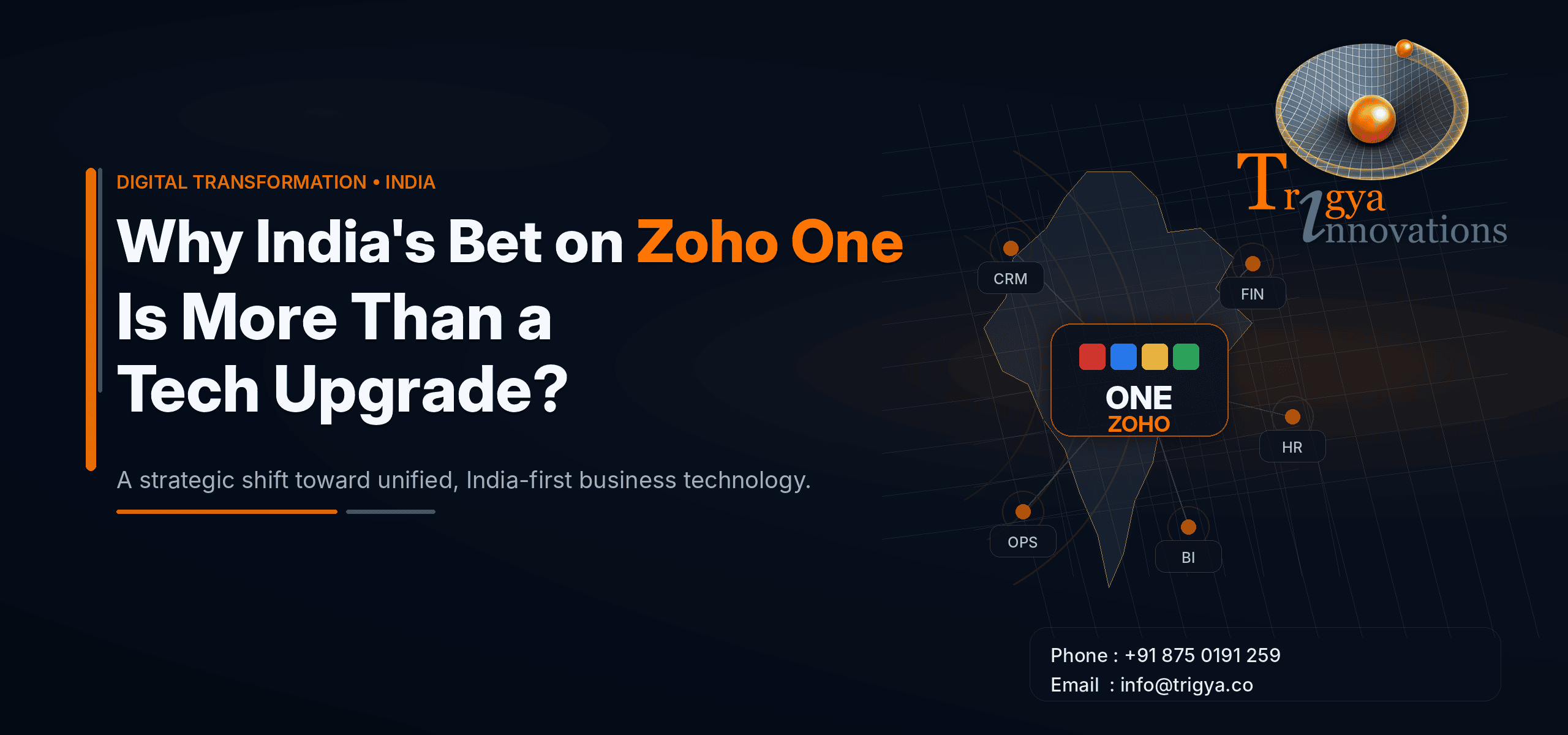
Strip away the political narrative, and the product case for Zoho One is straightforward. Zoho offers over 45 integrated applications covering CRM, marketing, finance, HR, collaboration, IT management, and analytics — designed for SMBs but built to scale.
The real advantage of Zoho One digital sovereignty for businesses is not the “Made in India” label. It is the integration. When your sales pipeline, finance workflows, helpdesk, and team communication all live within one connected ecosystem, you eliminate the data handoffs, duplicate entries, and compatibility issues that come with stitching together five different tools from five different vendors.
Zoho has also continued investing in its own infrastructure such as opening new data centres and designing in-house server hardware through its Nathu La initiative in 2026, which matters for organisations with data residency requirements or clients who ask where their information is stored.
For growing Indian businesses, this combination of breadth, integration, and local infrastructure is what makes Zoho One worth serious consideration.
Questions Worth Asking, Before You Adopt
Being a Zoho partner means being honest about what a good implementation looks like, and what it does not.
The honest takeaway: Zoho One is a strong platform. But any platform is only as effective as the way it is configured and used. The questions every business should ask before going live:
- Are data residency and access controls set up correctly for your context?
- Are your workflows mapped before implementation, or are you fitting your business around default settings?
- Do you have a partner who can customise the platform to how your team actually works?
What This Means for Your Business Right Now
The government’s adoption of Zoho creates practical tailwinds for private sector businesses. Supplier portals, compliance workflows, and government-facing communications are increasingly aligned with Zoho’s ecosystem. Businesses already on the platform will find those interactions easier to navigate over time.
More broadly, the policy direction is clear: India is prioritising home-grown digital infrastructure, and that will shape procurement preferences, compliance expectations, and partner ecosystems for years ahead. Getting ahead of that curve thoughtfully is a better position than catching up to it later.
This is exactly where Trigya Innovations, as a Zoho One Premium Partner, focuses its work. Not on selling licences, but on understanding how a business actually operates and building a Zoho One configuration that reflects that reality, so the platform works for the team, not the other way around.
The Bigger Picture
PM Modi’s endorsement of Sridhar Vembu amplified something that was already in motion. Zoho One digital sovereignty is not just a headline, it is a direction backed by ₹180 crore in government expenditure, 1.6 million migrated accounts, and a growing ecosystem of businesses making the same move for their own operational reasons.
Whether you are exploring Zoho One for the first time or looking to get more out of an existing implementation, the question worth asking is not whether this platform is relevant to India’s future. It clearly is. The question is whether your current setup is positioned to take full advantage of it.
If you would like a grounded, workflow-first conversation about what Zoho One could look like for your organisation, Trigya Innovations is a good place to start.