
The simplest answer is this: generative AI creates, while agentic AI acts.
Generative AI can write an email, summarize a report, create an image, draft code, or prepare a proposal. Agentic AI can take that output and move a task forward. It can plan steps, use business tools, check data, trigger workflows, and complete actions within defined rules. IBM explains this clearly: generative AI is mostly reactive to a user’s prompt, while agentic AI is more proactive and can adapt to changing situations.
This difference is important as more and more businesses are using AI for versatile purposes other than content generation across the organizations. Stanford’s 2025 AI Index reported that 78% of organizations used AI in 2024, up from 55% in 2023, while generative AI attracted $33.9 billion in global private investment.
Start with the easy idea
To understand What is the Difference Between Agentic AI and Generative AI?, think of a customer complaint.
Generative AI can read the complaint and draft a polite reply.
Agentic AI can read the complaint, check the customer’s order history, identify the issue, create a support ticket, suggest the next action, notify the right team, and prepare a response for approval.
That is the real difference. Generative AI helps with the message. Agentic AI helps with the process.
What generative AI does well
Generative AI is best when the task involves creation, explanation, or communication. It is useful for writing blogs, preparing sales emails, summarizing meetings, creating training content, translating documents, generating reports, and drafting code.
It works well because it saves time on first drafts. A team member still needs to review the output, check accuracy, adjust the tone, and decide what happens next. That human review is not a weakness. It is the control layer.
So, when someone asks What is the Difference Between Agentic AI and Generative AI?, a fair answer is that generative AI supports human thinking, but it usually does not manage the full workflow by itself.
What agentic AI does differently
Agentic AI goes beyond creating an answer. It works toward a goal. IBM describes agentic AI as a system that can accomplish a specific goal with limited supervision, often using AI agents that handle subtasks and coordinate through orchestration. (IBM)
In business terms, this means agentic AI can connect with CRM, ERP, helpdesk, finance, inventory, or operations systems. It may use generative AI inside the process, but the larger value comes from action. It can decide which step comes next, which system needs to be updated, and when a human should approve the result.
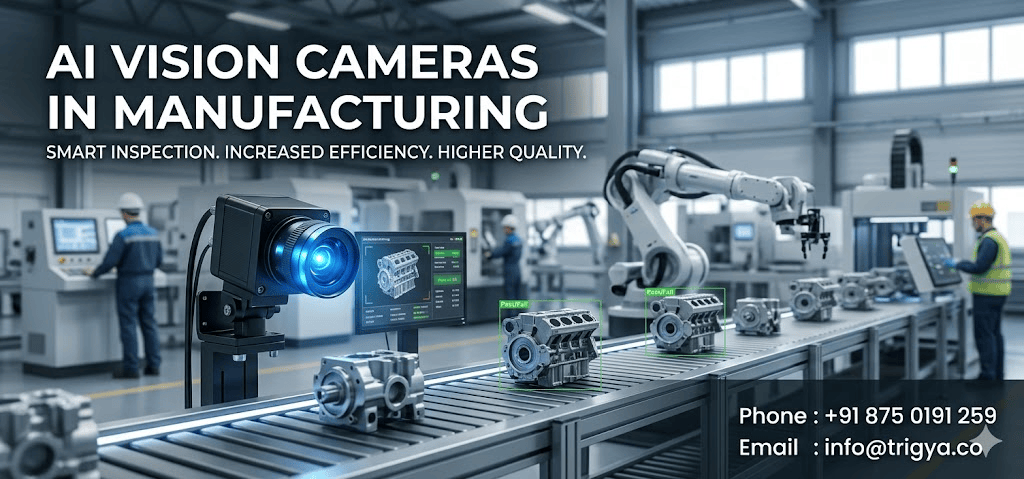
This is where the topic becomes practical for companies. Trigya Innovations, Zoho One Premium Partner, can help businesses look at AI through the lens of workflow improvement, not just content generation. For example, if a company uses AI-ML Vision cameras to detect a product defect, generative AI can describe the issue. Agentic AI can create a quality ticket, update the ERP record, alert the production team, and route the case for inspection.
The business difference is control
The cleanest way to answer What is the Difference Between Agentic AI and Generative AI? is to look at control.
Generative AI gives you output. Agentic AI manages steps.
Generative AI waits for a prompt. Agentic AI can continue working toward a goal.
Generative AI is useful for content and analysis. Agentic AI is useful for workflows and operations.
McKinsey describes AI agents as moving general-purpose copilots from passive tools into proactive teammates that can monitor dashboards, trigger workflows, follow up on open actions, and deliver insights in real time. But McKinsey also notes that real value depends on agents being aligned with company logic, data flows, and high-impact processes. (McKinsey & Company)
That last point is important. Agentic AI is not useful just because it sounds advanced. It becomes useful when the workflow is clear, the data is reliable, and the permissions are controlled.
Where each one fits
Generative AI is the better choice when the work is creative, language-heavy, or research-based. It helps teams move faster when writing, summarizing, explaining, designing, or brainstorming.
Agentic AI is the better choice when the work is repeatable and process-driven. It can support lead follow-ups, invoice checks, service scheduling, inventory alerts, customer support routing, employee onboarding, and quality control workflows.
Gartner predicts that by 2028, 33% of enterprise software applications will include agentic AI, up from less than 1% in 2024. Gartner also predicts that at least 15% of day-to-day work decisions will be made autonomously through agentic AI by 2028.
That does not mean every company should rush into agentic AI. It means companies should prepare their systems, data, and approval rules now.
The risk is higher with agentic AI
Generative AI can give a wrong answer. Agentic AI can take a wrong action.
That is why agentic AI needs stronger governance. A bad draft can be edited. A bad workflow action can update records, send incorrect messages, approve the wrong request, or trigger the wrong operational step.
NIST’s AI Risk Management Framework was created to help organizations manage AI risks to individuals, businesses, and society. This kind of structure matters more when AI systems are allowed to act, not just respond.
Conclusion
So, What is the Difference Between Agentic AI and Generative AI? Generative AI is the creator. Agentic AI is the operator.
Use generative AI when you need content, summaries, ideas, reports, or explanations. Use agentic AI when you need systems to complete repeatable work with clear rules, reliable data, and human approval where needed.
For businesses using ERP, CRM, automation, analytics, or AI-ML Vision cameras, Trigya Innovations, Zoho One Premium Partner, can help choose the right AI approach for the right business problem. The goal is not to chase a trend. The goal is to make work faster, clearer, and easier to control.