

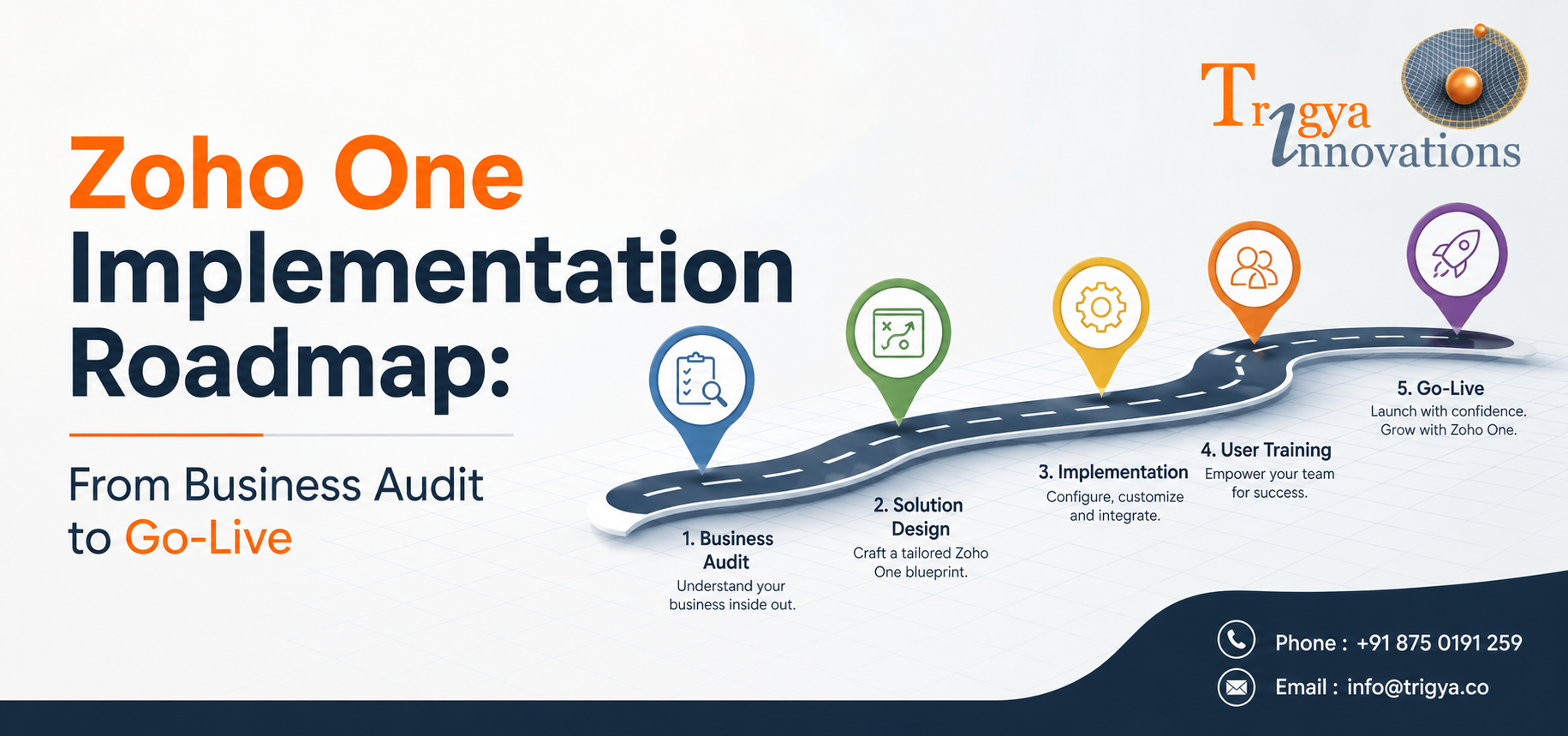
A Zoho One Implementation Roadmap is a structured sequence of phases — audit, configuration, migration, training, and go-live — that a business follows to deploy Zoho One without breaking the workflows it’s meant to improve.
Zoho One bundles more than 45 applications covering sales, finance, HR, and support under one login. That range is the appeal, and it’s also the risk: switch on too much, too fast, and teams end up with software that technically works but doesn’t match how anyone actually operates. A roadmap is what keeps the rollout tied to the business instead of the feature list.
What Is a Zoho One Implementation Roadmap?
It’s the plan that governs the order operations happen in, not just the list of tasks. Skipping ahead is where most of the friction in a rollout actually starts.
The pattern isn’t unique to Zoho. Panorama Consulting’s research puts the overall ERP failure rate at roughly 68%, with poor change management and messy data migration named as recurring causes. Projects run on unrealistic timelines are around 70% more likely to blow through both budget and schedule. A defined Zoho One Implementation Roadmap exists specifically to avoid becoming one of those numbers.
The Phases of a Zoho One Implementation Roadmap
Business audit
The audit maps how work actually happens today, not the version written up in a process document. It’s also where a business defines success in measurable terms. A recent checklist from Ksolves makes the same point: clarity on the actual goal, whether that’s CRM efficiency or workflow automation, should guide every decision that follows.
App and requirement mapping
Few businesses need all 45-plus apps on day one. This phase matches audited needs to specific tools — CRM for pipeline visibility, Books for finance, People for HR — instead of activating the whole suite at once. Dynamic Digital Solutions frames it simply: identify which apps align with the goals already defined, and build outward from there.
Configuration
Fields, layouts, roles, and permissions get shaped around the audited workflows here. The common misstep is over-customization, which is rebuilding every old process instead of adopting a cleaner one, which SME-focused guidance flags repeatedly as a drag on rollouts.
Data migration
Contacts, historical transactions, and open records get cleansed, deduplicated, and validated before anything touches the live environment. This phase consistently takes longer than internal teams plan for, typically three to four weeks on its own for a mid-market rollout (Lets Viz, 2026).
Integration
Zoho Flow or a middleware layer, connects Zoho One to whatever a business already runs such as payment gateways, logistics platforms, a legacy system, usually alongside the tail end of migration.
Training and user acceptance testing
Training works best when it’s role-specific: a sales rep and a finance lead don’t need the same session. UAT runs in parallel, surfacing configuration gaps while there’s still time to fix them quietly, rather than in front of the whole company on launch day.
Go-live and hypercare
Go-live isn’t the finish line, it opens a hypercare window where the implementation team stays close, catching the edge cases no discovery document fully anticipated. Buffering the go-live date, instead of treating it as fixed, protects both user confidence and that final stretch.
How Long Does It Actually Take?
Most mid-market Zoho One rollouts run 8 to 16 weeks end to end, with the range narrowing or widening depending on how much audit work happened before the project officially kicked off. Businesses that treat the audit and migration phases as seriously as the go-live date tend to land on the shorter end.
Getting the Sequence Right
A Zoho One Implementation Roadmap isn’t paperwork filed away after kickoff, it’s what keeps a rollout honest when the pressure to skip a step inevitably shows up. The businesses that get the most out of Zoho One treat the sequence itself as seriously as the launch date: less about switching on features quickly, more about making sure the platform still matches how the business works on the days nobody’s watching the dashboard.
Ready to Build Your Roadmap?
An audit, a phase-by-phase plan, and a go-live date are only as good as the team executing them. As a Zoho One Premium Partner, we work alongside businesses through every stage of this process from mapping workflows, choosing the right apps from the 45-plus in Zoho One, to handling migration and integration cleanly, and staying on through hypercare so the rollout holds up long after launch day.
If a Zoho One Implementation Roadmap is on the to-do list but nobody’s had the time to build one properly, that’s exactly where Trigya Innovations can step in. Get in touch to talk through what a rollout would look like for your business.