

Walk any modern production floor, and you’ll notice something. The cameras are watching, but most of them aren’t doing much beyond recording.
That’s changing fast. And the difference between a camera that records and one that thinks is larger than most manufacturers expect.
This article follows a product through its journey on the factory floor to show exactly what AI vision cameras in manufacturing do at each stage, and why companies that already have cameras installed may be closer to that upgrade than they realise.
What Makes a Camera “AI”?
A standard industrial camera captures an image. That image goes somewhere, a monitor, a storage server, maybe a human inspector. The camera’s job expands there.
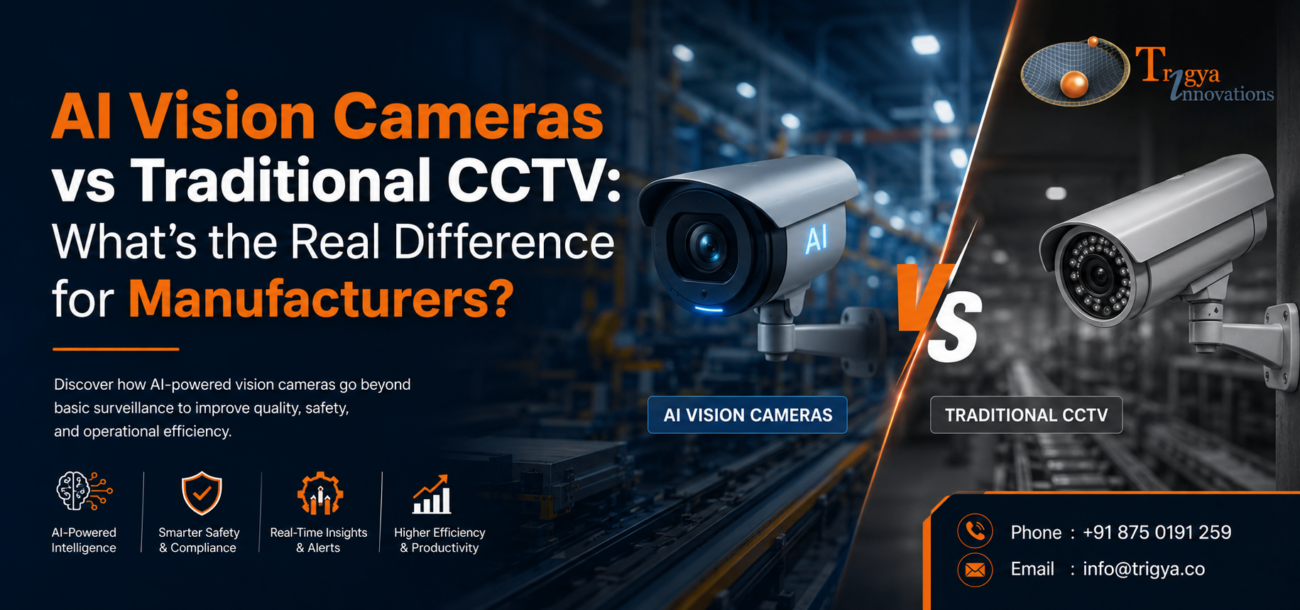
An AI vision camera does more. It captures the image and interprets it, in real time, on its own, without waiting for a person to look at a screen. It’s been trained on thousands of examples of what good looks like, what defective looks like, and every variation in between. Change the lighting, adjust the product design, introduce a new material, and, unlike its rule-based predecessor, an AI camera adapts.
Unlike rule-based systems that require pre-defined criteria and consistent defect types, AI-based vision systems learn patterns from vast image datasets and can identify anomalies, even those that haven’t been previously encountered. That’s the core difference. And it’s why manufacturers are moving fast.
The global AI-based machine vision and quality inspection market was valued at USD 7.9 billion in 2024 and is projected to reach USD 28.4 billion by 2031, growing at a CAGR of 20.2%. That growth isn’t speculation, it’s coming from real production problems: defects slipping through, downtime eating margins, and inspection teams that simply can’t process parts at the speed a modern line demands.
Now let’s follow a product through the floor to see where AI vision cameras in manufacturing actually show up.
Stage 1: Assembly: Helping Machines Build Things Right
Before anything can be inspected, it has to be built. And building things precisely, at speed, across thousands of cycles a day, is harder than it sounds.
Finding and placing the right parts. Components move. They’re mixed in bins, travelling on belts, rotating on pallets. AI cameras embedded in robotic arms can locate parts by shape, position, or orientation, and hand that information to the robot in milliseconds. They can sort mixed components, count inventory, and catch a misplaced part before it becomes a misbuilt product.
Getting the measurements right. Tolerances in manufacturing are unforgiving. A millimetre off in one component can cascade into a failed assembly two stages later. AI vision systems analyse images in 3D to verify dimensions, length, width, surface profile without slowing the line down.
Guiding the robot through complex tasks. Welding, soldering, painting, fastening, these tasks require precision that humans struggle to sustain across a full shift. AI cameras give robots the spatial awareness to perform these operations consistently, every time. The camera sees. The robot acts.
Stage 2: Quality Control: Catching What Human Eyes Miss
This is where AI vision cameras in manufacturing earn the most attention, and for good reason.
Manual inspection has a ceiling. An experienced inspector reviewing parts at high speed will catch most defects, but not all of them, not consistently, and not forever. Fatigue is real. Subjectivity is real. At the volumes modern factories operate at, “most” isn’t good enough.
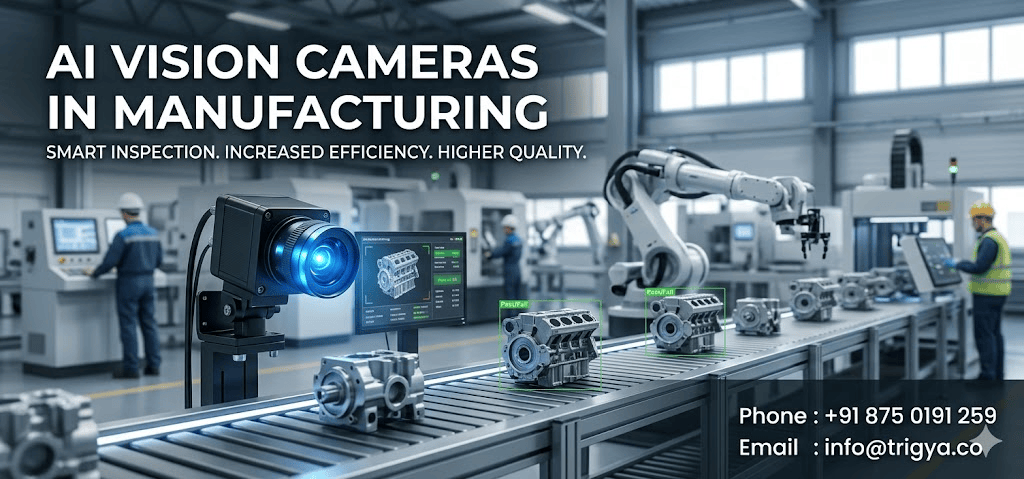
Defect detection at microscopic scale.AI-powered vision systems can identify surface anomalies, cracks, discolorations, or structural deviations at a microscopic level, often beyond the resolution of the human eye or traditional inspection tools. That’s not a slight on human inspectors; it’s a physical reality. The camera resolves detail no eye can match, and it does it in under 200 milliseconds per unit, fast enough to keep pace with the line without creating a bottleneck.
The industries where this matters most: semiconductors (where a defect smaller than a human hair can ruin a chip), pharmaceuticals (where regulatory compliance requires 100% inspection, not sampling), and automotive (where a faulty weld becomes a field safety issue). AI-powered vision systems in manufacturing can reduce defect rates by up to 30%, with leading deployments reporting error reductions of up to 90% in controlled environments.
Predictive maintenance before the breakdown. Equipment doesn’t fail suddenly, it deteriorates. Vibration patterns shift. Surfaces corrode. Components heat up in ways they shouldn’t. AI cameras running thermal or multi-spectral imaging can detect these early signals and flag them before they become unplanned stoppages. AI-based predictive maintenance can reduce unplanned downtime by up to 50% and lower maintenance costs by 20–30%. For context: in automotive manufacturing, a single minute of unplanned downtime can cost upwards of $20,000.
Worker safety, monitored continuously. Are workers wearing the right PPE? Has someone entered a restricted zone? Is there an early heat signature that could indicate fire? AI cameras positioned across the facility can track all of this in real time. This isn’t surveillance for its own sake, it’s continuous compliance at a scale no safety team can achieve manually.
Stage 3: Packing, Labelling, and Getting It Out the Door
A product that passes inspection still needs to be packed correctly, labelled accurately, and sent to the right place.
AI vision cameras in manufacturing verify all of this at the final stage. Is the packaging sealed properly? Does the label match the product inside? Is the batch code correct? These checks take milliseconds per unit and catch errors that would otherwise reach the customer, or worse, trigger a recall.
Traceability is the other side of this. By reading and logging barcodes, QR codes, and serial numbers at multiple points through the production journey, AI vision systems create a complete record of where a product was made, when, on which line, and with which components. If something goes wrong in the field, that record makes root cause analysis possible, instead of guesswork.
Can You Upgrade Your Existing Cameras With AI?
Here’s what often surprises manufacturers when this conversation comes up: upgrading to AI vision doesn’t always mean replacing the cameras already on the floor.
Modern AI vision platforms are increasingly designed to work with existing hardware. The intelligence, the deep learning model, the edge processor, the decision layer, can sit separately from the camera itself. Some platforms support universal integration with cameras already in place, whether line scan, area scan, thermal, or hyperspectral. AI-powered inspection can be added to any existing vision system, including line scan, microscope, x-ray, hyperspectral, and area scan cameras already in service.
This matters for the business case. A full AI vision installation with new hardware runs from $15,000 for a single-station setup to well over $100,000 for complex multi-camera environments. When existing cameras can be retained and upgraded through software and edge AI layers, the entry cost drops substantially, and ROI within 12 to 18 months is now the standard expectation for facilities that commit to the transition. High-end systems regularly deliver over 75% return in year one through labour savings, waste reduction, and quality improvements.
This is exactly the kind of assessment Trigya Innovations helps manufacturers work through, figuring out what the existing infrastructure actually supports and what the most practical upgrade path looks like, rather than defaulting to a full replacement conversation.
A Few Things Worth Knowing Before Starting :
Training data takes time. AI models need labelled examples to learn from. Rare defect types are particularly difficult to capture in volume early in a deployment. Self-supervised learning is reducing this barrier, but it hasn’t removed it.
Integration isn’t plug-and-play. Connecting vision systems to PLCs, MES platforms, or ERP systems adds deployment time. Open standards help, but customisation is still required for facilities running legacy equipment.
Older lines may need retrofitting.Plants on older infrastructure may need physical modifications before AI software layers can be applied. This is a reason to do a proper site assessment first, not a reason to avoid the upgrade altogether.
Skilled people are still required. Deploying and tuning these systems well requires someone who understands both manufacturing and AI. That combination remains a genuine challenge, particularly for smaller manufacturers.
Conclusion
Computer vision in manufacturing has already moved from basic quality control to real-time 3D visual inspection, now detecting defects, micro-cracks, material inconsistencies, faulty assemblies, that were simply invisible to previous systems. The roadmap from here points toward edge AI shrinking latency further, hyperspectral imaging expanding what’s detectable, and tighter integration with robotics enabling cameras not just to flag a problem but to trigger the corrective action automatically.
The manufacturers getting ahead of this aren’t necessarily the largest. They’re the ones that have stopped treating inspection as a cost of doing business and started treating it as a competitive edge.
If you’re wondering whether your existing cameras can carry an AI upgrade, or what a realistic installation looks like for your specific facility, Trigya Innovations works through exactly that question. The goal isn’t to sell you more hardware than you need. It’s to find the shortest path from where your floor is today to where you want it to be.