

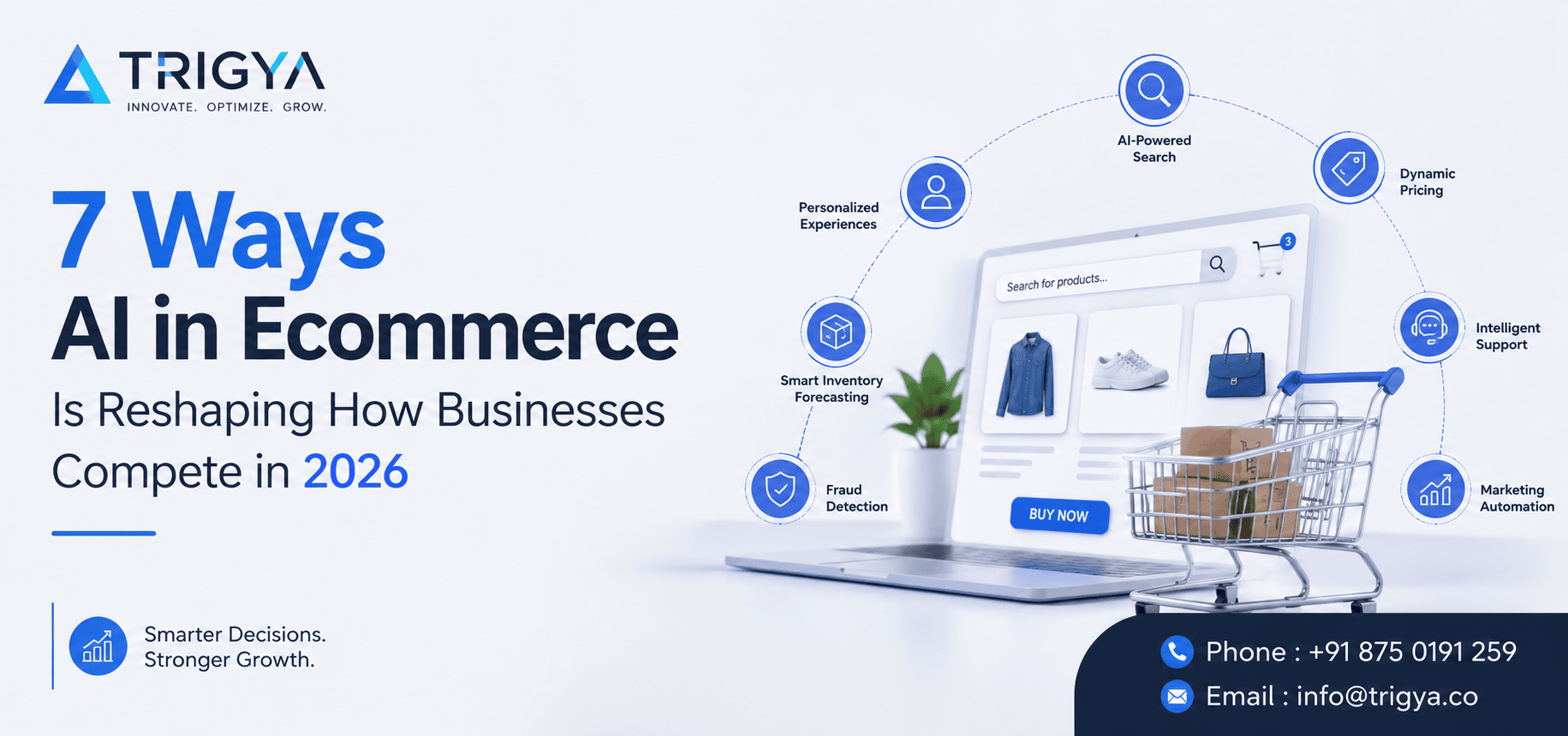
E-commerce businesses today are operating under a different kind of pressure. Customer expectations have moved faster than most operational systems. Margins are thinner. Acquisition costs are higher. And the volume of decisions that need to happen like pricing, inventory, personalisation, support, has outpaced what manual processes can reliably handle.
AI in e-commerce doesn’t solve all of that overnight. But it changes the unit economics in ways that matter: faster decisions, more accurate forecasting, and customer experiences that scale without proportional increases in headcount.
With global ecommerce AI expected to reach $22.60 billion by 2032, the question for most businesses is where to start and what to expect.
This article covers the seven shifts that are already happening and what each one actually means in practice.
What AI in Ecommerce Actually Does
AI processes data and executes decisions at a speed and scale that no operations team can match. It identifies patterns across millions of customer interactions, adjusts in real time, and learns continuously from each transaction.
The business impact is measurable. McKinsey estimates generative AI alone could add $240–$390 billion in annual value to retail, not through headcount reduction alone, but through precision that manual operations structurally cannot achieve.
For ecommerce specifically, this plays out across seven distinct areas.
7 Ways AI Is Changing Ecommerce in 2026
1. Personalisation Becomes the Default, Not the Exception
Customers no longer compare you to your direct competitors. They compare you to every personalised experience they’ve had with Netflix, Spotify, Amazon. When they don’t get relevance, they leave.
AI makes personalisation operational. Machine learning analyses browsing patterns, purchase history, and real-time intent signals to surface the right product at the right moment, not a best guess based on category, but a prediction based on that specific customer’s behaviour. Businesses leading in personalisation grow revenue 10–15% faster than those who don’t, and product recommendations alone can drive up to 31% of total site revenue.
The gap isn’t in knowing personalisation works. It’s in executing it consistently across every channel.
2. Search Moves From Keywords to Intent
A customer typing “something warm for a winter wedding” doesn’t want a results page filled with generic wool coats. They want something that understands what they actually mean.
AI-powered search does this by mapping intent rather than matching terms. It accounts for context, past behaviour, and product attributes to return results that convert. Adobe’s data shows generative AI-driven traffic to retail sites grew 4,700% year-over-year, with those visitors spending 32% more time on site. Smarter search reduces dead-end sessions and recovers conversions that keyword-based systems miss entirely.
3. Customer Support Scales Without Proportional Cost
Support is one of the most expensive functions in ecommerce to scale. Every new market, every peak season, every product expansion creates volume that teams struggle to absorb.
AI-powered chatbots now handle approximately 70% of online customer conversations, resolving order queries, returns, and product questions in seconds rather than hours. When generative AI is layered in, these systems handle complex questions, not just scripted flows. The result is lower support costs and faster resolution times, without sacrificing quality on routine interactions. Human agents focus on what actually requires judgment.
4. Inventory Forecasting Stops Being Reactive
Stockouts and overstock are expensive in opposite directions. One loses the sale. The other ties up working capital and triggers markdowns. Both are, to a significant extent, preventable.
AI forecasting models process hundreds of variables simultaneously, historical demand, promotional calendars, supplier lead times, seasonal patterns, even external signals like weather and social trends. Early adopters report 15% lower logistics costs, 35% reductions in inventory levels, and 65% improvements in service levels.
This is an area where businesses working with technology partners like Trigya Innovations, a Zoho One Premium Partner, often find the clearest operational gains. When AI-powered forecasting integrates with an ERP or CRM system already managing day-to-day operations, inventory decisions become data-driven by default rather than by exception.
5. Pricing Becomes a Strategic Variable, Not a Static Decision
On major ecommerce platforms, prices shift thousands of times a day. This isn’t guesswork, it’s demand-aware pricing calibrated to real-time signals: competitor moves, inventory levels, customer segments, and conversion data.
AI in e-commerce makes this feasible without a team of analysts. Retailers using AI-driven pricing report margin improvements of up to 10%, and personalised promotions can lift average order values by around 22%. The nuance worth noting: aggressive dynamic pricing without guardrails erodes trust. The strongest implementations tie pricing intelligence to segmentation showing the right price for the right customer, not simply the lowest price for everyone.
6. Fraud Detection Moves From Reactive to Preventive
Ecommerce fraud doesn’t announce itself. It looks, at first glance, like a legitimate transaction. Rule-based detection systems catch the obvious cases. They miss the sophisticated ones, and they block legitimate customers in the process.
AI-based fraud detection analyses transaction patterns, device fingerprints, location signals, and behavioural sequences in milliseconds. It flags anomalies before the order processes, rather than investigating chargebacks after the fact. 75% of IT leaders report that AI significantly enhances security in their systems. Beyond loss prevention, better detection means fewer false positives as legitimate customers who get blocked rarely come back.
7. Marketing Automation Moves From Scheduling to Orchestration
Most ecommerce marketing still runs on a calendar. Emails go out on Tuesdays. Cart abandonment sequences trigger after 24 hours. Campaigns blast to entire lists regardless of where each customer is in their journey.
AI in e-commerce replaces scheduling with orchestration. It decides when to reach a customer based on what they just did, what they’re likely to do next, and which message format is most likely to convert. Omnisend’s data shows AI-automated flows generate over 50% of email revenue for ecommerce brands, with AI-driven sequences achieving 332% higher click rates than standard campaigns. Repeat purchase rates improve 15–20% when personalisation extends across the full lifecycle, not just the acquisition funnel.
The Common Thread Across All Seven
Each of these shifts shares the same underlying dynamic: decisions that used to require human bandwidth at every step are now handled by systems that learn continuously and execute at scale.
That doesn’t mean implementation is frictionless. Data quality matters. Integration with existing systems matters. The businesses seeing the strongest returns are the ones treating AI adoption as an operational projec,t tied to specific outcomes, rather than a technology experiment.
If you’re working through where AI fits within your ecommerce stack, particularly within a Zoho ecosystem, Trigya Innovations brings the implementation depth to make that transition practical. The value of AI in ecommerce compounds over time, the earlier the infrastructure is in place, the wider the advantage becomes.