
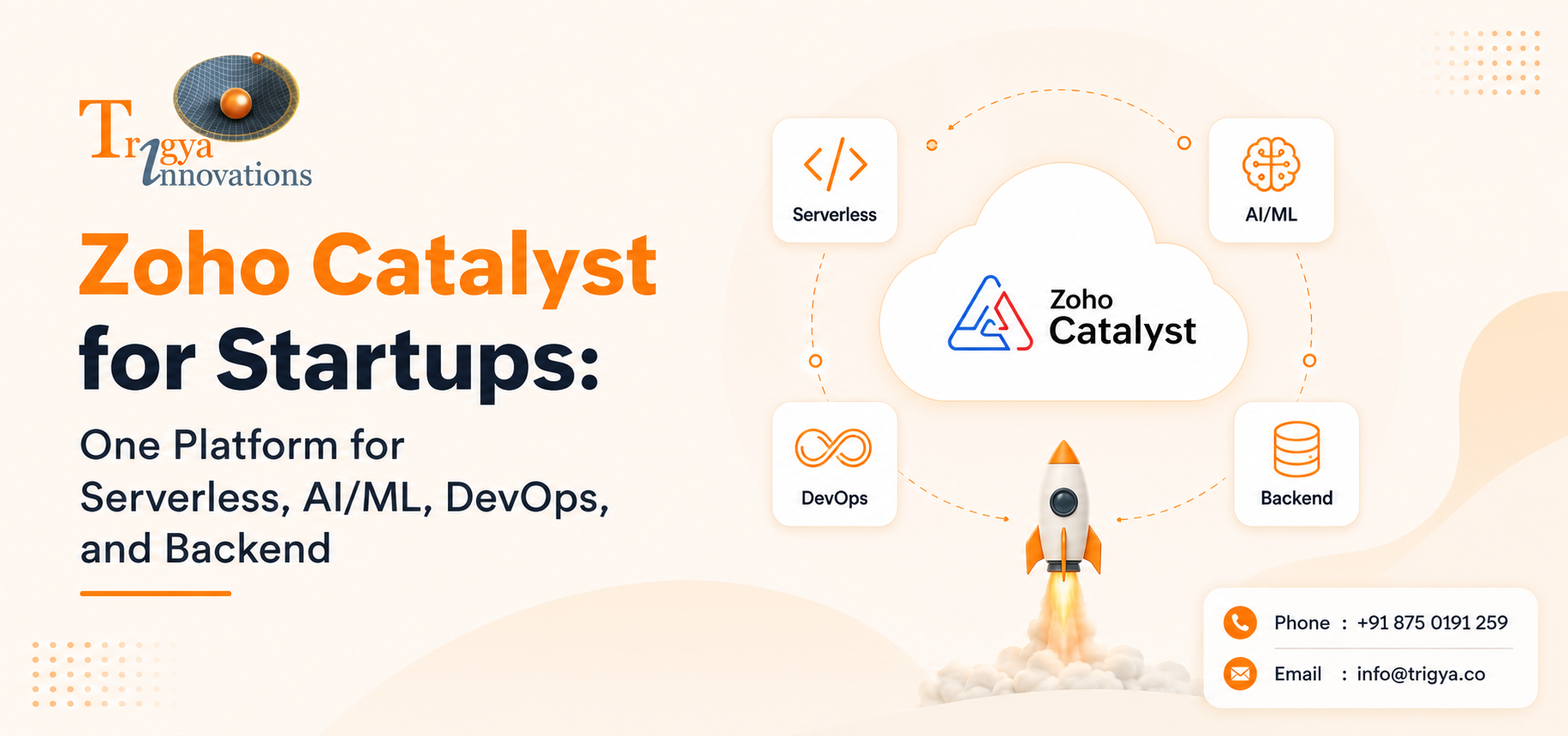
Building software products used to mean one thing before you wrote a single line of code: figure out the infrastructure. Provision servers. Configure load balancers. Set up CI/CD pipelines. Worry about scaling. For an early-stage startup, this is the wrong problem to be solving. Every hour spent on infrastructure is an hour not spent on your product. That’s the gap Zoho Catalyst for startups fills : a single, unified platform that handles serverless compute, AI/ML pipelines, DevOps tooling, and backend services, so teams can move from idea to deployment without the overhead.
The timing matters. The global serverless computing market stood at roughly $25 billion in 2025 and is projected to reach $91 billion by 2031, growing at nearly 23% annually. Businesses aren’t just chasing cost savings anymore, they’re using serverless infrastructure to accelerate digital products, automate DevSecOps, and handle real-time AI workloads that scale unpredictably. For startups operating on lean budgets, this shift is transformational.
What Is Zoho Catalyst, Really?
At its core, Zoho Catalyst is a full-stack, cloud-based development platform. It provides backend services, Functions-as-a-Service (FaaS) components, DevOps tools, and AI/ML microservices, and it manages all underlying server infrastructure entirely on your behalf. You write the code. Catalyst handles provisioning, scaling, uptime, and performance.
This matters more than it might sound. Traditional cloud platforms charge for idle compute time. Catalyst’s pay-as-you-go model means developers only pay for resources consumed while their code is actually running, no upfront costs, no long-term commitments. For startups with variable traffic and unpredictable workloads, this alone can make a significant difference to the runway.
But Zoho Catalyst for startups isn’t just about cost. It’s about compression, compressing the time between “we have an idea” and “users are using it.”
The Four Pillars: Serverless, AI/ML, DevOps, Backend
i. Serverless Functions (FaaS)
Catalyst’s serverless functions let developers write logic that executes in response to HTTP requests or events, without any server management. You can code locally, deploy globally, and scale automatically as demand rises. The platform’s CLI enables instant deploys and real-time monitoring. For a startup launching an MVP, this removes weeks of infrastructure work.
ii. AI/ML with QuickML and Zia
This is where Catalyst genuinely differentiates itself. QuickML is a no-code ML pipeline builder with built-in Generative AI capabilities, including LLM serving and Retrieval-Augmented Generation (RAG). Its drag-and-drop interface covers the full ML lifecycle: data ingestion, preprocessing, model training, deployment, and monitoring. A startup building a churn prediction model or a demand forecasting tool doesn’t need a dedicated data science team to get started, QuickML handles it.
Alongside QuickML, Catalyst’s Zia services offer ready-to-use AI components including OCR, sentiment analysis, object detection, and keyword extraction, all accessible via API with minimal configuration. These aren’t toy features. They’re the same AI capabilities Zoho has refined across 50+ products serving over 60 million users.
iii. DevOps, Built In
Zoho Catalyst for startups includes decoupled environments for development, staging, and production, with CI/CD support and a full local debugging sandbox that’s free to use until you deploy to production. The platform offers up to 125 million free function invocations, giving teams real runway to build and test before incurring costs. That’s a meaningful free tier, not a marketing hook.
iv. Backend as a Service
Catalyst also provides built-in authentication, databases, APIs, and file storage under one roof. Developers can move from idea to deployment in hours, not weeks, because the platform manages scaling, uptime, and performance while they focus on writing logic.
Where Trigya Innovations Comes In
For startups navigating the Zoho ecosystem, having the right partner changes outcomes. As a Zoho One Premium Partner, Trigya Innovations helps companies implement Zoho Catalyst alongside broader Zoho One solutions, from initial architecture decisions to deployment and ongoing optimisation. The difference between “we installed it” and “it works for us” is usually in that implementation layer.
An Honest Assessment
Zoho Catalyst isn’t a magic wand. Teams coming from AWS or Google Cloud will find the ecosystem smaller, fewer third-party integrations, a less extensive community, and documentation that occasionally lags behind feature releases. If your stack is deeply tied to Kubernetes or proprietary cloud-native tooling, migration has real friction.
What Catalyst does exceptionally well is consolidation. Serverless frameworks can reduce infrastructure-related expenses by up to 40%, and the value multiplies when AI/ML, DevOps, and backend services are unified in one billing account, one console, and one support relationship. For a 5-person startup that can’t afford three separate platform contracts and three separate learning curves, that consolidation is the point.
Who Should Be Looking at This
- Early-stage startups that need to ship fast without hiring a DevOps engineer
- Indie developers and freelancers building client applications or SaaS products
- SMBs modernising legacy apps who want serverless without ripping out their stack entirely
- Teams already in the Zoho ecosystem through CRM, Desk, or Books, Catalyst plugs into all of them natively
The Bottom Line
Zoho Catalyst for startups is a serious option in a market where serious options are usually expensive. It brings serverless compute, no-code ML pipelines, integrated DevOps, and a full backend layer under one roof, with a pricing model that respects the reality of early-stage economics. Nearly 60% of enterprises report enhanced operational agility after adopting serverless, and startups stand to gain even more given how much of their early time is typically consumed by infrastructure decisions that don’t move the product forward.
If you’re evaluating your backend and AI infrastructure stack, and you’re already thinking about how Zoho One fits into your operations, it’s worth a conversation with Trigya Innovations before you lock into a more complex, more expensive architecture. Sometimes the best technical decision is the one that lets your team keep building.