
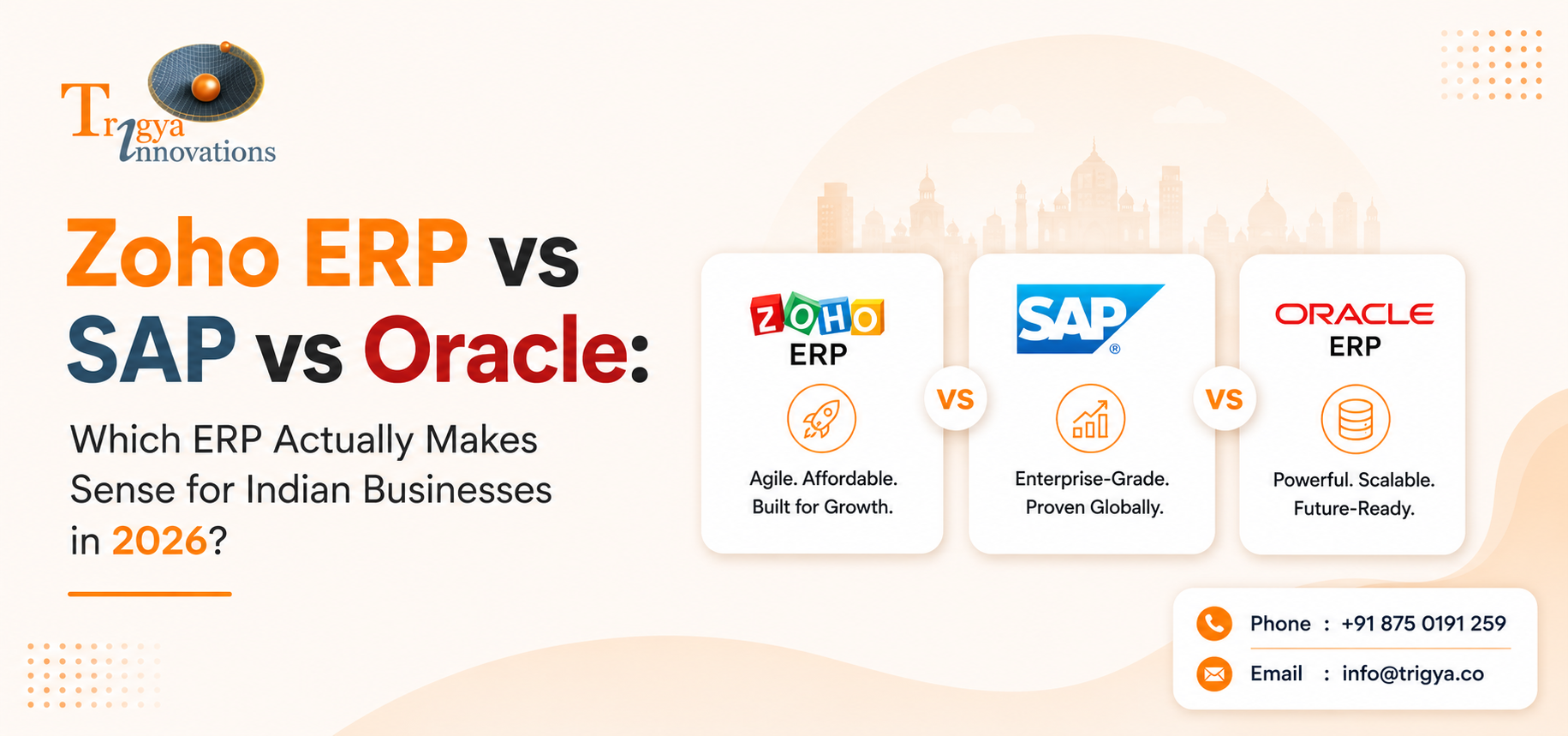
If you run a growing business in India, you’ve probably had this conversation: your finance team is stitching together Tally exports and spreadsheets, your sales team is living in a separate CRM, and nobody has a real-time view of what’s happening. Someone suggests an ERP. Then three names come up — Zoho, SAP, Oracle — and suddenly the decision feels overwhelming. This guide cuts through the noise so you can make a clear-headed choice between Zoho ERP vs SAP vs Oracle before committing your budget, your people, and the next 12 months of your operations.
Why This Decision Is Different for Indian Businesses
Most ERP comparison articles are written with a US or European business in mind. Indian businesses face a genuinely different compliance landscape: GST returns, e-invoicing mandated for ₹5 crore+ turnover businesses through the Invoice Registration Portal (IRP), e-Way bills, EPF, ESI, TDS, and Professional Tax obligations. A platform that doesn’t handle these natively forces you into expensive middleware or painful workarounds.
Beyond compliance, the Indian SME market has historically been held back from ERP adoption by three friction points: high licensing costs, multi-month implementation cycles, and heavy dependence on expensive consultants. Zoho’s own research confirmed this when it launched its ERP platform in January 2026, describing the Indian SME opportunity as “hundreds of millions of dollars” precisely because existing ERP options had priced smaller firms out of the conversation.
That context matters before you even open a vendor’s pricing page.
The Three Contenders: A Grounded Overview
i. Zoho ERP : The India-First Challenger
Zoho officially launched its dedicated ERP product on January 23, 2026, positioned as India’s first AI-native enterprise resource planning system. Built over five years from its Kumbakonam, Tamil Nadu development centre, the platform unifies finance, supply chain, manufacturing, payroll, and commerce into a single system with embedded AI, including its voice-based assistant, Ask Zia.
What’s genuinely different here is the compliance architecture. Zoho ERP includes built-in alignment with India’s Digital Public Infrastructure ecosystem: GSTN compliance, e-invoicing mandates, UPI payment acceptance, EPF, ESI, TDS, Professional Tax, and Labour Welfare Fund obligations. These aren’t add-ons configured by a consultant, they’re embedded by design. Payments are also built directly into the platform, automatically linking collections, vendor payouts, and salary disbursements to orders, invoices, and ledgers.
Pricing starts at approximately $29/month, scaling to $249/month depending on features and scale, making it more than 10 times cheaper than SAP and Oracle on a per-user basis. Implementation timelines for SMEs typically run 4 to 12 weeks.
Best for: SMEs and growing mid-market businesses (₹5 crore to ₹500 crore revenue range) that want India-compliant, affordable, fast-deploy ERP without a multi-year transformation programme.
ii. SAP : The Enterprise Benchmark
SAP remains the dominant ERP at the top end of India’s corporate market. Reliance, Tata, Infosys, Wipro, and HDFC Bank-tier organisations run SAP S/4HANA as their system of record for financials, procurement, and supply chain. The platform’s functional depth is genuinely unmatched in areas like complex manufacturing, multi-entity global consolidation, and advanced supply chain orchestration.
But that depth comes with a price. SAP Business One for SMEs costs ₹10,000 to ₹2,50,000 per year in licensing alone, while SAP S/4HANA implementations routinely run $1,000,000 to $3,000,000 and above. Implementation timelines for large deployments stretch 12 to 24 months. The system requires a significant pool of certified SAP consultants to configure and maintain, and those consultants don’t come cheaply in the Indian market.
SAP S/4HANA and Oracle Fusion do handle IndAS (Indian Accounting Standards, converged with IFRS) dual reporting, which is a non-negotiable requirement for listed Indian companies and large unlisted ones. That’s genuinely valuable for enterprises where the compliance bar is set by the Securities and Exchange Board of India.
Best for: Large Indian enterprises (₹500 crore+ revenue, listed companies, multi-entity conglomerates) with complex, global operations and the budget and team to match.
iii. Oracle Fusion Cloud ERP : The BFSI and Enterprise Choice
Oracle Fusion Cloud ERP holds strong position in India’s banking, financial services, and insurance (BFSI) sector (ICICI, Kotak, and Bajaj Finance-tier organisations), where Oracle’s database and Exadata infrastructure is already the backbone. Oracle’s pricing tiers start at $80–$175 per user per month, with enterprise implementations similarly landing in the $1,000,000–$3,000,000+ range.
Like SAP, Oracle handles IndAS and IFRS dual reporting, DPDP Act 2023 compliance structures (India’s new data privacy law), and IRP integration for e-invoicing. The platform’s strength is in financial reporting sophistication, advanced controls, and its deep integration with Oracle’s broader technology stack.
The honest limitation: Oracle’s UI complexity, steep learning curves, and heavy dependence on specialised implementation partners make it a poor fit for any organisation that doesn’t have a dedicated IT team and a multi-year digital transformation roadmap.
Best for: Large BFSI-sector enterprises and infrastructure-heavy organisations already invested in the Oracle technology ecosystem.
A Practical Comparison on the Factors That Matter Most
The Honest Middle Ground: What Nobody Tells You
This is where it’s worth stepping back from the specs.
Many Indian SMEs have been sold SAP Business One because of the brand name, and have then struggled with cost overruns, implementation delays, and system complexity that their teams never fully adopted. That’s not a failure of the software in isolation; it’s a mismatch between tool and context. A ₹50 crore manufacturing company in Pune does not have the same ERP needs as Tata Steel.
Equally, some fast-growing businesses in the ₹200–500 crore range have assumed that Zoho is “too small” for them, and missed the fact that the platform’s new ERP offering is explicitly designed for this segment. The addressable opportunity in India, according to Zoho’s own team, is precisely the companies that have outgrown Tally but aren’t yet ready (in cost or complexity) for a full SAP deployment.
This is where working with an experienced implementation partner changes the outcome more than the software choice itself. Trigya Innovations, a Zoho One Premium Partner, works with Indian businesses across this exact mid-market segment, helping companies navigate the implementation, customise workflows, and ensure that the platform actually fits the business rather than forcing the business to fit the platform. The right ERP poorly implemented delivers worse outcomes than a simpler system deployed with discipline.
When to Choose Each Platform : A Decision Framework
i. Choose Zoho ERP if:
- Your revenue is between ₹5 crore and ₹300 crore
- You need GST, e-invoicing, EPF, and UPI compliance without months of configuration
- Your implementation timeline is measured in weeks, not years
- You want a single vendor for ERP, CRM, HR, and analytics under Zoho One
- You value cost predictability over maximum customisation depth
ii. Choose SAP if:
- Your revenue exceeds ₹500 crore and you operate across multiple legal entities
- You’re a listed company with IndAS dual-reporting obligations
- You have a dedicated IT team and can budget ₹1 crore+ for implementation
- You operate in complex manufacturing or global supply chain environments
iii. Choose Oracle if:
- You’re in the BFSI sector with existing Oracle infrastructure
- Your compliance needs include advanced financial controls (SEBI, RBI mandates)
- You have a multi-year digital transformation programme with board-level sponsorship
The Bigger Picture: ERP Is a Business Decision, Not a Software Decision
The ERP market globally is a $66 billion market, with cloud and AI driving a new adoption cycle. Zoho’s entry as an AI-native, India-made platform specifically targeting the compliance and cost barriers that have held back Indian SME adoption marks a genuine structural shift, not just a new product announcement. Government departments and PSUs are also now evaluating Indian alternatives to global software, which signals a longer-term tailwind.
But the platform choice is ultimately secondary to the implementation discipline. The businesses that get the most from their ERP, whether Zoho, SAP, or Oracle, are those that map their actual processes before selecting a system, invest in change management alongside software rollout, and choose an implementation partner with real operational experience rather than a presentations deck.
If you’re evaluating Zoho ERP vs SAP vs Oracle for your Indian business and want a structured recommendation based on your specific revenue, compliance requirements, and growth plans, Trigya Innovations offers an initial consultation that starts from your business reality rather than a vendor preference. The right system is the one your team actually uses.
The ERP landscape in India is moving faster than it has in the past decade. Whatever platform you choose, the cost of waiting — in manual processes, compliance risk, and operational inefficiency — is almost always higher than the cost of deciding.