

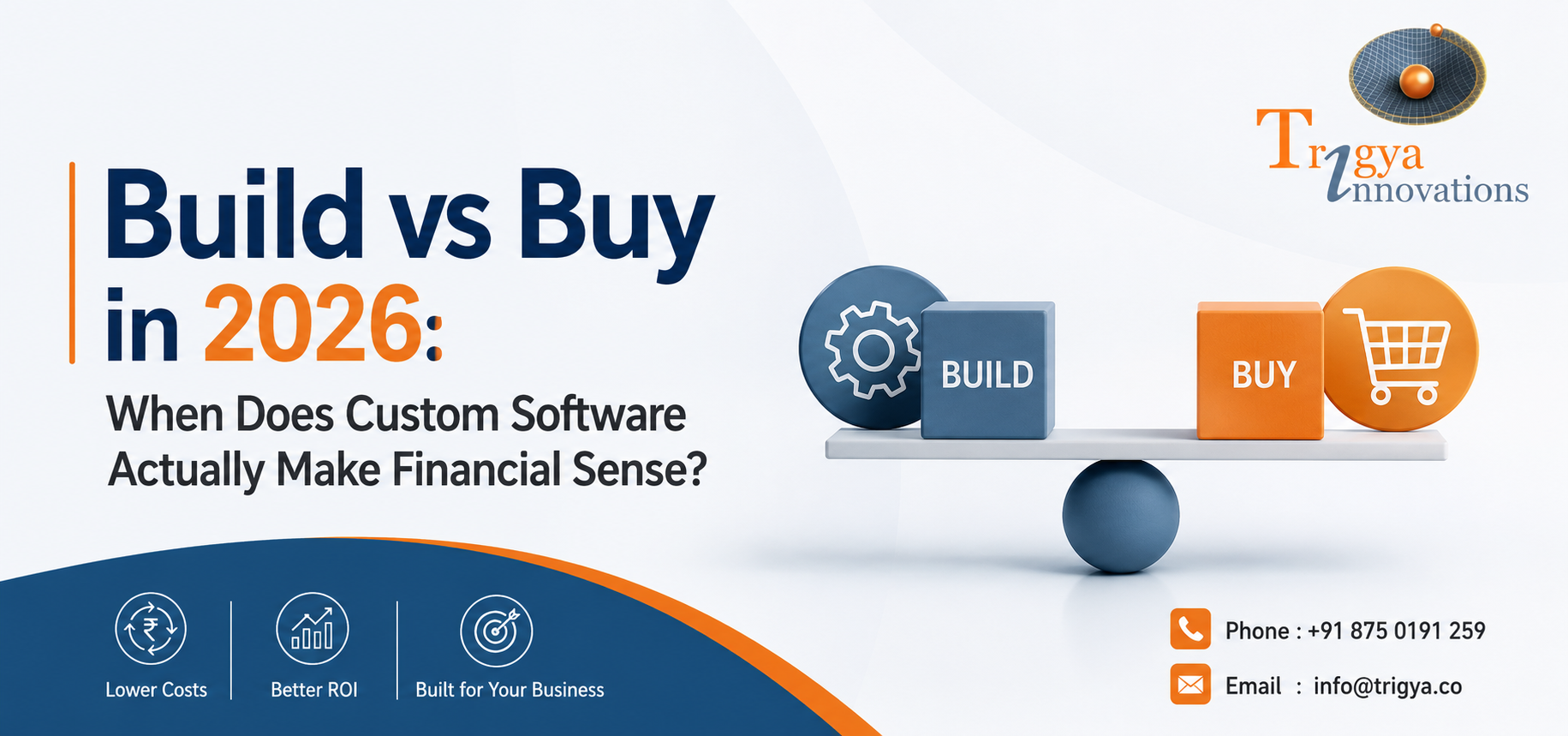
Most businesses eventually face the same question: keep paying for software that doesn’t quite fit, or build something that does. This is the build vs buy decision, and it used to have a simple answer: buy, unless you had months of development time to spare.
That answer isn’t so simple anymore. Custom development has gotten faster and cheaper, thanks to AI-assisted tools and low-code platforms. At the same time, SaaS subscriptions have gotten pricier, with per-seat charges and paywalled features adding up over time.
This piece looks at what actually goes into a build vs buy decision in 2026, so the choice can be based on real numbers instead of a gut call.
Why the Calculation Has Changed
For most of the last decade, build vs buy was a short conversation. Unless a company had a spare development team and six months to burn, it bought the SaaS tool and adjusted its workflow around it. That default no longer holds automatically.
A few shifts explain why:
- Build costs have dropped. A widely cited 2026 industry analysis found that AI-assisted development has pushed the cost of building custom software down to roughly 10-20% of what traditional custom development used to cost, making the build side of the equation far more competitive than it was even two years ago.
- Buy costs are less predictable than they look. A 2026 build vs buy guide notes that SaaS platforms carry a hidden total cost of ownership of 2.5x to 4x their headline pricing once integrations, workarounds, and scaling costs are factored in.
That second point is exactly why so many finance and operations teams are re-running the build vs buy analysis on tools they signed up for years ago.
The Real Cost Comparison: Five Years, Not Five Months
The single biggest mistake in any build vs buy decision is comparing a monthly subscription fee against a one-time development quote. They aren’t the same unit of measurement. A framework from a UK-based technology advisory puts it plainly: the build vs buy decision should always compare total cost of ownership over five years, not sticker price against a development quote.
Stretched across five years, a modest monthly SaaS fee for ten or twenty users can outpace a well-scoped custom build, especially once license increases, add-on modules, and workaround time get added in.
The buy side, though, genuinely wins in specific situations. If a process is a commodity, like payroll, email, or basic accounting, most build vs buy frameworks agree buying is the sensible default. As one 2026 guide summarizes, if a process is a commodity, buy it; if it’s core to how you compete and operate, building deserves serious consideration. The task is being honest about which category a process actually falls into.
Where Custom Development Tends to Win
A few patterns show up repeatedly across recent build vs buy research. Custom development tends to make financial sense when:
- The SaaS bill has outgrown the SaaS usage. A team pays for a large subscription but only uses a fraction of its features.
- Compliance or data requirements are non-negotiable. A generic platform can’t accommodate them without expensive workarounds.
- Growth is fast enough to hit the tool’s ceiling. The subscription that fit last year no longer scales with the team.
A 2026 cost analysis found that mid-market companies with differentiated operations, regulated data environments, or fast growth trajectories most often see a better five-year return from custom development than from staying on generic SaaS.
The Middle Ground: Hybrid Builds
Build vs buy isn’t always an either/or choice. A growing number of organizations now run a hybrid approach: buying commodity infrastructure, like payments or communications, and building a thin custom layer on top that encodes their own business rules. It’s a practical way to control cost while still getting a system tailored to how the business actually operates.
Low-code platforms have made this middle path far more accessible. On the Zoho side, this is a pattern we see often at Trigya Innovations: clients rarely need a from-scratch engineering team to get a tailored solution. Tools like Zoho Creator let a business build a genuinely custom application, complete with its own workflows, approval chains, and client portals, without the multi-month timeline or six-figure budget that pure custom development usually demands. “Custom” and “expensive” have stopped being synonyms in 2026.
Making the Call
Before committing either way, it helps to run the build vs buy analysis function by function rather than deciding once for an entire tech stack:
- Calculate what a tool actually costs over five years, including every workaround the team has learned to live with.
- Determine whether the process in question is a genuine competitive differentiator or a commodity task every company handles the same way.
- Check whether the platform being evaluated scales with the business, or whether this same decision will resurface in eighteen months.
Run through those three questions honestly, and the right answer tends to be far clearer than the build vs buy debate usually makes it feel.
Final Word
The build vs buy decision in 2026 rewards businesses that compare real five-year costs rather than sticker prices, and that separate commodity processes from the ones core to how they compete. Custom development has become dramatically more accessible, buying still wins for standardized workflows, and a hybrid approach often captures the best of both.
If you’re weighing a build vs buy decision on Zoho and want a second opinion grounded in real project numbers rather than a vendor pitch, Trigya Innovations, as a Zoho One Premium Partner, can map your specific workflows and pin down whether a low-code build, an off-the-shelf module, or a hybrid setup actually pencils out for your business. Reach out for a free consultation, and let’s work through it together.